

Florida hit and run lawyer: Top 3 Shocking Facts 2025
When You’re Left Behind: Understanding Florida Hit and Run Cases
If you need a Florida hit and run lawyer, here’s what you need to know:
- Free Consultation: Most Florida hit and run attorneys offer free case evaluations
- No Upfront Costs: Attorneys typically work on contingency (no win, no fee)
- Act Quickly: Florida has a 2-year statute of limitations for injury claims
- Available Compensation: Medical bills, lost wages, pain and suffering, vehicle damage
- Own Insurance: Your PIP and uninsured motorist coverage may apply even if the driver isn’t found
A hit and run accident can turn an ordinary day into a nightmare in seconds. In Florida, where nearly 25% of all crashes involve a driver who flees the scene, victims often feel doubly victimized – first by the crash itself, then by being abandoned.
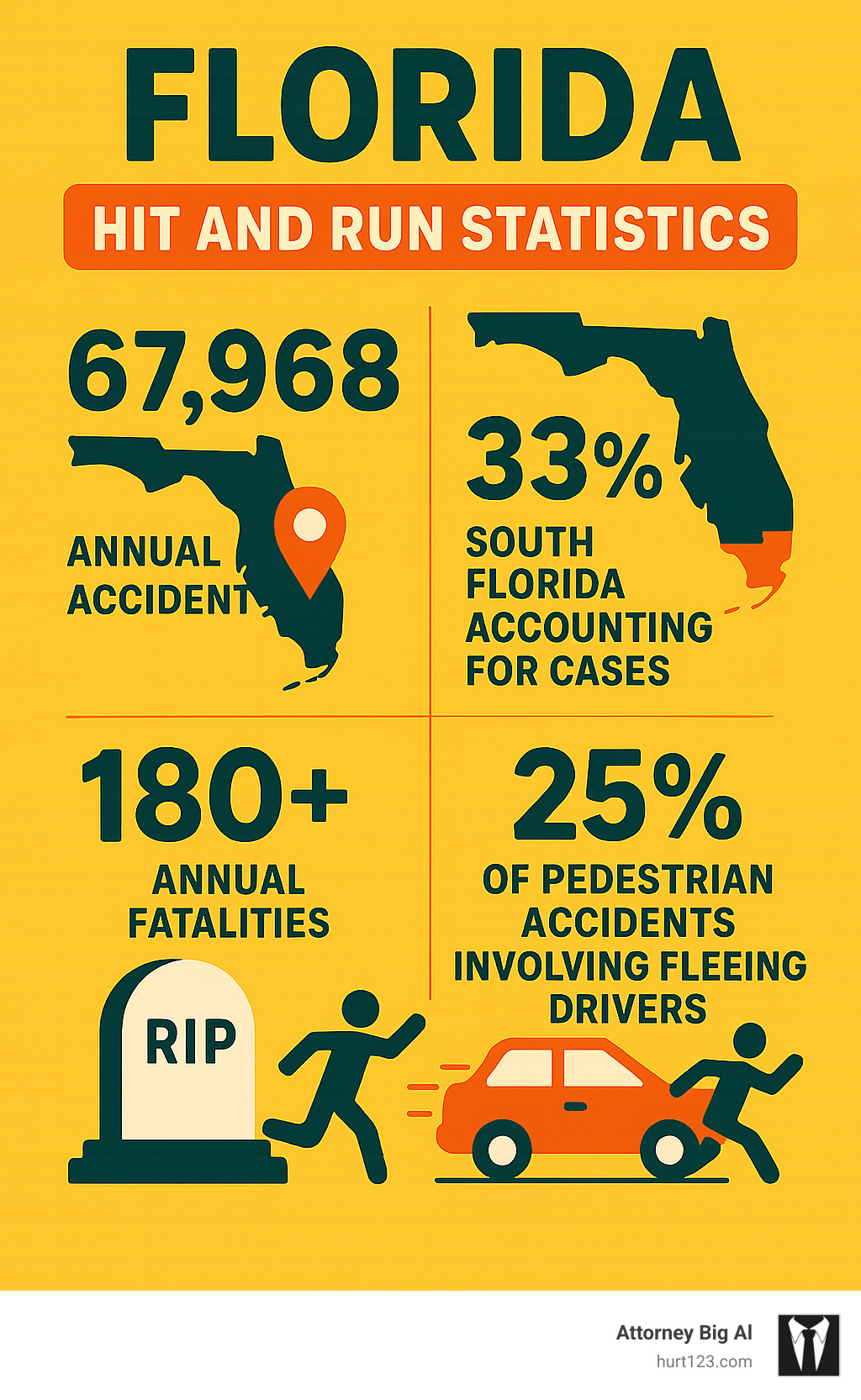
Florida experiences an alarming number of hit and run accidents each year. In 2012 alone, there were 67,968 hit-and-run accidents in the state, with South Florida accounting for one-third of these incidents. More troubling still, over 180 people were killed in Florida hit and run crashes in 2015, and approximately 1 in 4 pedestrian crashes involve a driver fleeing the scene.
When a driver crashes into your vehicle, a pedestrian, or property and leaves without providing identification or assistance, they’ve committed a hit and run. This isn’t just morally wrong – it’s a criminal offense in Florida that can result in severe penalties, including jail time and hefty fines.
The immediate aftermath of a hit and run can be overwhelming. You’re left dealing with injuries, vehicle damage, mounting medical bills, and the frustration of not knowing who caused your suffering. This is precisely when having a skilled Florida hit and run lawyer becomes essential.
A specialized attorney can help steer insurance claims, investigate to potentially identify the fleeing driver, and ensure you receive fair compensation – whether through your own insurance coverage or by pursuing the responsible party if they’re eventually found.
Florida hit and run lawyer helpful reading:
– Car accident attorney Florida
– Florida brain injury attorney
– Florida defective product attorney
Fort Lauderdale: Understanding Hit & Run Laws and Driver Duties
In Fort Lauderdale and throughout Florida, hit and run accidents are governed by specific laws that outline driver obligations and potential penalties. Under Florida Statutes 316.061, 316.062, and 316.063, all drivers involved in a collision have clear legal duties they must fulfill.
A hit and run occurs when a driver involved in an accident fails to stop at the scene and comply with their statutory obligations. The severity of penalties depends on the outcome of the crash:
| Crash Result | Classification | Potential Penalties |
|---|---|---|
| Property damage only | Second-degree misdemeanor | Up to 60 days in jail, $500 fine |
| Non-serious injury | Third-degree felony | Up to 5 years in prison, $5,000 fine, 3-year license revocation |
| Serious injury | Second-degree felony | Up to 15 years in prison, $10,000 fine |
| Death | First-degree felony | 4-30 years in prison, $10,000 fine, permanent license revocation |
These penalties are significantly improved if the driver was under the influence at the time of the crash. In such cases, there’s a mandatory minimum two-year prison sentence for DUI-related hit-and-run with injury or death.
According to the Florida Highway Safety and Motor Vehicles (FLHSMV), hit and run crashes remain a serious issue statewide, with drivers often fleeing due to impairment, lack of a valid license, or no insurance coverage.
What Counts as Leaving the Scene?
Under Florida law, “leaving the scene” refers to a driver’s failure to stop and remain at the crash location until they have fulfilled all their legal obligations. This applies to three main scenarios:
-
Property Damage (Florida Statute 316.063): When a driver hits an unattended vehicle or damages property and leaves without making reasonable efforts to locate the owner or leaving contact information.
-
Crashes Involving Injury (Florida Statute 316.027): When a driver flees after causing injury to another person, which is classified as a felony.
-
Crashes Resulting in Death (Florida Statute 316.027): The most serious category, resulting in first-degree felony charges with potential prison sentences of 4 to 30 years.
Even briefly leaving the scene (except to get cell service with the intention of immediately returning) can constitute a hit and run offense. The law doesn’t recognize “I panicked” or “I didn’t know what to do” as valid defenses.
Mandatory Actions Drivers Must Take
Florida law requires specific actions from all drivers involved in an accident:
-
Stop Immediately: Drivers must stop as close as possible to the scene without obstructing traffic more than necessary.
-
Exchange Information: Provide your name, address, vehicle registration number, and upon request, show your driver’s license to the other party involved.
-
Render Reasonable Assistance: If someone is injured, you must provide “reasonable assistance,” which includes arranging transportation to medical facilities if needed or requested.
-
Report the Accident: If police don’t respond to the scene, you must file a report with the nearest law enforcement agency as soon as possible.
-
Unattended Vehicle or Property: If you hit an unattended vehicle or property, you must make a reasonable effort to locate the owner or leave a note with your contact information in a conspicuous place.
Failure to perform these duties can transform an otherwise minor accident into a serious criminal offense with life-altering consequences. That’s why, as Florida hit and run lawyers, we strongly advise all drivers to understand and comply with these obligations, regardless of who caused the accident.
Hollywood: First 60 Minutes After the Collision—Protecting Your Rights

The clock starts ticking the moment a hit and run driver flees the scene in Hollywood. Those first 60 minutes aren’t just crucial—they can make or break your ability to recover physically, emotionally, and financially. As a victim left behind, your actions now will shape everything that follows.
When the unexpected happens, your first priority is always safety. Check yourself and your passengers for injuries, remembering that adrenaline often masks pain. If possible, move to a safe location away from traffic to prevent a bad situation from becoming worse. Then, immediately call 911 to report the accident and request police and medical assistance.
Even if you feel “fine,” don’t skip medical attention. Florida law requires accident victims to seek medical treatment within 14 days to qualify for Personal Injury Protection (PIP) benefits. This isn’t just a legal technicality—many serious injuries, particularly those affecting the brain and spine, may not show symptoms immediately.
While you might feel the urge to chase after the fleeing driver, resist this impulse. It’s dangerous and could potentially undermine your claim later. Instead, focus your energy on documenting every detail you can remember about the vehicle—make, model, color, and any portion of the license plate you glimpsed.
Florida hit and run lawyer tip: The information you gather in these first moments can become invaluable evidence. Note the exact time and location of the accident, current weather and road conditions, and any distinctive features of the fleeing vehicle. Look around for potential witnesses and politely ask for their contact information. These individuals might have seen details you missed in the chaos of the moment.
Documenting and Reporting the Crash
The quality of your documentation directly impacts your case’s strength. Take comprehensive photos from multiple angles showing both the damaged and undamaged areas of your vehicle. Include close-ups of specific damage points and wider shots capturing the entire accident scene.
Witness testimony can be powerful evidence. When speaking with bystanders, collect their names, phone numbers, and email addresses. Ask if they’d be willing to provide a statement to police or your attorney later. Their observations might include critical details about the fleeing driver or vehicle that you didn’t notice.
Don’t overlook potential video evidence. Scan the area for businesses, traffic cameras, or residential doorbell cameras that might have captured the accident. This footage can be game-changing in identifying the hit and run driver.
When police arrive, provide as much detail as possible for the official report. Request a copy or at least note the report number—this document becomes a cornerstone for insurance claims and potential legal action. And importantly, don’t rush to repair your vehicle. The damage patterns and any paint transfer can sometimes help identify the fleeing vehicle through forensic analysis.
Why Drivers Flee – Common Motives
Understanding what motivates a driver to flee can actually help in tracking them down. The most common reasons aren’t mysterious—they’re predictable human reactions to fear of consequences.
Impaired driving tops the list. Drivers under the influence often make the split-second calculation that a hit and run charge might be less severe than a DUI, especially if they have prior offenses. Those without a valid license face an immediate legal crisis when involved in any accident, making flight seem like their only option.
Many drivers flee because they have no insurance coverage and fear financial responsibility. Others may have outstanding warrants and know that police involvement could mean immediate arrest. And sometimes, it’s simply panic or fear—particularly among younger or inexperienced drivers who become overwhelmed by the situation.
According to AAA research, the typical hit and run driver fits a specific profile: usually a young male between 19-27 years old, often with previous traffic violations or license issues. These drivers account for approximately 70% of cited hit-and-run cases.
In Hollywood and throughout South Florida, knowing these patterns helps investigators focus their search efforts. At Attorney Big Al, we work alongside law enforcement and private investigators to pursue every possible lead in identifying drivers who flee accident scenes.
The first hour after being left behind by a hit and run driver is undoubtedly traumatic. But by taking the right steps in those critical moments, you create the foundation for protection—both of your immediate well-being and your long-term legal rights.
Miami: Insurance Coverage, Compensation, and Unidentified Drivers
The busy streets of Miami present unique challenges for hit and run victims. With one-third of Florida’s hit-and-run crashes happening in South Florida, knowing your insurance options isn’t just helpful—it’s essential for your recovery.
As a Florida hit and run lawyer team serving Miami residents, we’ve guided countless victims through the maze of insurance claims after these traumatic incidents. Florida’s no-fault system provides some protection, but there’s often confusion about what’s actually covered.
Let’s start with your immediate protection. Your Personal Injury Protection (PIP) insurance—mandatory for all Florida drivers—covers 80% of your medical expenses and 60% of lost wages up to your $10,000 policy limit. This coverage kicks in regardless of who caused the accident, making it your first financial safety net after a hit and run.
But what happens when your medical bills exceed $10,000? This is where Uninsured Motorist Coverage becomes invaluable. Though not required by Florida law, this optional coverage treats the missing driver as uninsured, providing compensation beyond your PIP limits for additional medical costs, lost income, and even pain and suffering.
For your vehicle repairs, Collision Coverage will typically pay for damages minus your deductible. Many Miami drivers also carry MedPay, which handles the 20% of medical expenses not covered by PIP and can extend beyond your PIP limits.
Time is critical in these cases. Florida recently reduced the statute of limitations for injury claims from four years to just two years, giving victims less time to file. This makes prompt action more important than ever.
Navigating Claims When the At-Fault Driver Is Unknown
When the driver who hit you disappears into Miami traffic, pursuing compensation becomes challenging—but we’ve developed effective strategies to help our clients recover.
First, we conduct thorough investigations, often revealing crucial evidence. We review traffic camera footage from Miami’s extensive network, speak with witnesses from the scene, and sometimes check local body shops for vehicles with damage matching your accident description.
Your insurance company will require proof that physical contact occurred with another vehicle—this distinguishes your legitimate hit and run claim from a single-vehicle accident. We help gather and present this evidence convincingly.
Insurance companies often undervalue hit and run claims, so we handle all communications with them, ensuring they don’t minimize your legitimate damages. We also compile comprehensive medical documentation that clearly demonstrates your injuries and necessary treatments.
In some cases, we’ve identified third parties who share liability, such as companies whose commercial vehicles were involved or vehicle owners who negligently allowed the hit and run driver to use their car.
The most important thing to remember: even if the driver is never found on Miami’s busy streets, you’re not without options. Your own insurance policies often provide significant protection, and we know how to maximize these benefits for you.
Types of Damages Hit & Run Victims Recover
Miami hit and run victims may recover several types of compensation:
Economic damages cover tangible financial losses. These include current and future medical expenses, lost wages if you can’t work, property damage to your vehicle, rehabilitation costs, transportation to medical appointments, and even home modifications if your injuries require them.
Non-economic damages address the personal toll of your injuries. Pain and suffering, emotional distress, loss of enjoyment of life, mental anguish, and compensation for permanent disability or disfigurement all fall into this category. These damages recognize that the impact of a hit and run goes far beyond medical bills.
In rare cases where we identify the hit and run driver and their conduct was particularly outrageous, punitive damages may be available. These additional damages are designed to punish truly reckless behavior and deter others from similar actions.
Florida’s insurance typically covers only a portion of your losses—80% of medical expenses and 60% of lost wages up to policy limits. This often leaves significant out-of-pocket costs for Miami hit and run victims. Our team works diligently to identify all possible sources of compensation so you aren’t shouldering financial burdens while trying to heal from your injuries.
The complex nature of Miami hit and run cases makes having knowledgeable guidance particularly valuable. With the right approach, many victims secure the compensation they need to move forward with their lives, even when the responsible driver remains unidentified.
Boca Raton Guide: Building Your Case with a Florida hit and run lawyer
In Boca Raton and throughout Florida, building a strong hit and run case requires specialized knowledge and resources that most victims simply don’t have. Our team at Attorney Big Al brings the experience and dedication needed to investigate these challenging cases and fight for the compensation you deserve.
How a Florida hit and run lawyer Collects Critical Evidence
The strength of your hit and run case often hinges on the evidence we gather. When you work with us, we leave no stone unturned in our investigation process.
We start by obtaining all police reports and investigation files, which often contain crucial witness statements, officer observations, and physical evidence notes that might help identify the driver who fled. These official documents form the foundation of your case.
Time is truly of the essence when it comes to traffic and surveillance footage. We quickly identify and secure video from nearby businesses, residential doorbell cameras, and traffic monitoring systems before this valuable evidence is deleted or recorded over. You’d be surprised how often these cameras capture crucial details that can break a case wide open.
Modern forensic techniques allow us to analyze vehicle paint transfer from the collision. This evidence can sometimes be matched to specific vehicle makes and models, potentially narrowing down the search for the hit and run vehicle to a particular color and type.
Witness statements often contain details that weren’t initially shared with police. Our team conducts thorough interviews, sometimes uncovering that a bystander noticed a partial license plate, distinctive vehicle features, or driver characteristics that weren’t in the original report.
For serious cases, we work with accident reconstruction experts who analyze skid marks, debris patterns, and your vehicle damage to determine exactly how the collision occurred and identify the type of vehicle involved. This scientific approach can reveal crucial details about the fleeing vehicle.
We also monitor social media (you wouldn’t believe how often drivers post about their accidents online) and canvas local body shops looking for vehicles with damage patterns consistent with your accident. Sometimes, the simplest investigative techniques yield the best results.
As Florida hit and run lawyers, we understand the critical nature of time in these investigations. Evidence disappears quickly and memories fade, which is why we act swiftly to preserve everything that might help your case.
Contingency Fees & Costs Explained by a Florida hit and run lawyer
At Attorney Big Al, we believe everyone deserves quality legal representation regardless of their financial situation. That’s why we handle hit and run cases on a contingency fee basis – a system designed to give you access to justice without adding financial stress during your recovery.
You’ll pay no upfront costs to get started with your case. Our initial consultation is completely free, and we’ll evaluate your situation without any obligation. This gives you the chance to understand your options without financial pressure.
Our fee structure is simple: no fees unless we win. Our payment comes as a percentage of the compensation we recover for you. If we don’t win your case, you owe us nothing for our time and legal work. This arrangement aligns our interests with yours—we only get paid when you do.
We believe in transparent fee arrangements, which is why we clearly explain our contingency fee at the beginning of your case. Typically, this ranges from 33% to 40% of the recovery, depending on whether the case settles before filing a lawsuit or goes to trial. There are never any surprises about how our fee is calculated.
We also advance all case expenses including investigation costs, expert witness fees, filing fees, and other litigation expenses. These are only reimbursed if and when we secure compensation for you. This means you don’t have to worry about paying for the sometimes substantial costs of building a strong case.
With our financial resources and experience challenging major insurance companies, we can level the playing field for hit and run victims in Boca Raton and throughout Florida. When you’re already dealing with medical bills and possibly lost income, the last thing you need is to pay attorney fees out of pocket.
Sunrise: Deadlines, Fault Rules, and Taking the Case to Court

Time isn’t on your side after a hit and run accident in Sunrise or anywhere in Florida. Understanding the deadlines that govern your case can mean the difference between receiving fair compensation and walking away empty-handed. As Florida hit and run lawyers, we’ve seen too many people lose their rights simply because they waited too long to act.
Statute of Limitations Checklist
Florida’s legal clock starts ticking the moment your accident occurs, and the countdown can feel painfully short when you’re dealing with injuries and vehicle repairs:
For personal injury claims, Florida recently shortened the filing window to just two years from the accident date. This 2023 change (down from four years) makes quick action more important than ever.
If your loved one lost their life in a hit and run, surviving family members have a two-year window from the date of death to file a wrongful death lawsuit. These cases require special care and sensitivity, which is why families often appreciate having a compassionate advocate by their side.
For property damage only situations, you have a bit more breathing room – four years from the accident date to seek compensation for your vehicle repairs and other damaged property.
Missing these deadlines isn’t like being late for a dinner reservation where they might still seat you. When the statute of limitations expires, courts typically dismiss your case outright, no matter how strong your evidence or how severe your injuries.
There are some situations where these deadlines can be “paused” or extended. If the hit and run driver deliberately hides their identity, the clock might not start until they’re identified. Children’s deadlines may extend until they reach adulthood, and those with certain mental incapacities might receive extensions as well. These exceptions aren’t guaranteed though, which is why connecting with a Florida hit and run lawyer quickly is your safest approach.
Civil vs. Criminal Proceedings at a Glance
Hit and run cases often travel down two parallel legal paths – criminal and civil. Understanding the difference helps you set realistic expectations about what each process can accomplish.
The criminal case is the government’s show. A prosecutor decides whether to charge the hit and run driver, and their goal is punishment – potential jail time, fines, and license suspension. The burden of proof is “beyond a reasonable doubt,” the highest legal standard. As the victim, you’re essentially a witness in this process, not a driving force.
Your civil case is where you take control. This is your path to financial recovery for medical bills, lost wages, pain and suffering, and other damages. The standard of proof is lower – “preponderance of evidence” or “more likely than not” – making it possible to win your civil case even if the criminal charges don’t stick.
These two processes operate independently but can influence each other. A criminal conviction can strengthen your civil case dramatically, though it’s not required. Even if the driver faces no criminal consequences, you can still pursue and win civil damages.
Criminal courts may order the driver to pay you restitution, but these amounts rarely cover all your losses. Your civil case remains the most reliable route to full compensation, which is why having a dedicated Florida hit and run lawyer matters so much.
Comparative Negligence in Florida Hit and Run Cases
Florida’s approach to shared fault changed significantly in 2023 with the adoption of a modified comparative negligence system featuring a critical 50% threshold.
Under this system, your compensation directly connects to your level of responsibility. If you’re found to be 30% at fault (perhaps you were slightly speeding when the hit and run occurred), you can still recover 70% of your damages. However – and this is the big change – if you’re deemed more than 50% responsible, you cannot recover anything at all.
This 50% rule makes building a strong case even more important, especially in hit and run situations. The fleeing driver’s attorney will often try to shift blame to you, arguing that their client ran because they panicked, not because they were at fault for the actual collision.
It’s worth noting that the act of leaving the scene doesn’t automatically make the driver 100% liable for the accident itself. The circumstances of the collision are evaluated separately from the criminal act of fleeing, which is why thorough investigation and evidence preservation are so crucial.
When you work with our team in Sunrise, we focus on building the strongest possible case to minimize any finding of comparative fault. We know that every percentage point matters when it comes to your financial recovery.
The path to justice after a hit and run isn’t always straight or simple, but you don’t have to steer it alone. With the right legal partner, you can focus on healing while we handle the deadlines, documentation, and legal strategies that protect your right to fair compensation.
Frequently Asked Questions about Florida Hit & Run Claims
Do I still have a case if I was partly at fault?
Yes, you can still pursue compensation even if you shared some responsibility for the accident. Florida follows a comparative negligence system that allows recovery as long as you weren’t more than 50% at fault for what happened.
Here’s how it works in practical terms: if a court determines you were 20% responsible for the accident and your total damages amount to $100,000, you would still be eligible to receive $80,000. This principle applies even when the other driver fled the scene.
It’s worth noting that insurance companies often try to inflate your percentage of fault to minimize their financial responsibility. As Florida hit and run lawyers, we fight these tactics by gathering evidence that accurately portrays the accident circumstances, ensuring you’re not unfairly blamed for something that wasn’t your fault.
What if police never find the driver?
Being the victim of a hit and run where the driver is never identified can feel deeply unfair, but you still have several paths to compensation:
Your uninsured motorist (UM) coverage becomes your financial lifeline in these situations. This optional coverage essentially steps in to take the place of the missing driver’s insurance, covering your medical expenses, lost income, and pain and suffering beyond what basic PIP provides.
Your mandatory Personal Injury Protection (PIP) will cover 80% of your medical bills and 60% of lost wages up to $10,000, regardless of who caused the crash. If you have collision coverage, it will pay for vehicle repairs minus your deductible.
Sometimes when police investigations stall, our firm works with skilled private investigators who use different techniques to track down fleeing drivers. Through surveillance footage analysis, social media monitoring, and witness interviews, we’ve helped identify drivers who thought they’d escaped accountability.
In certain situations, we might identify other responsible parties. For instance, if poor road design contributed to the crash, we may be able to pursue a claim against the government entity responsible for road maintenance.
How long will my hit & run settlement take?
The timeline for resolving hit and run claims varies considerably based on several key factors.
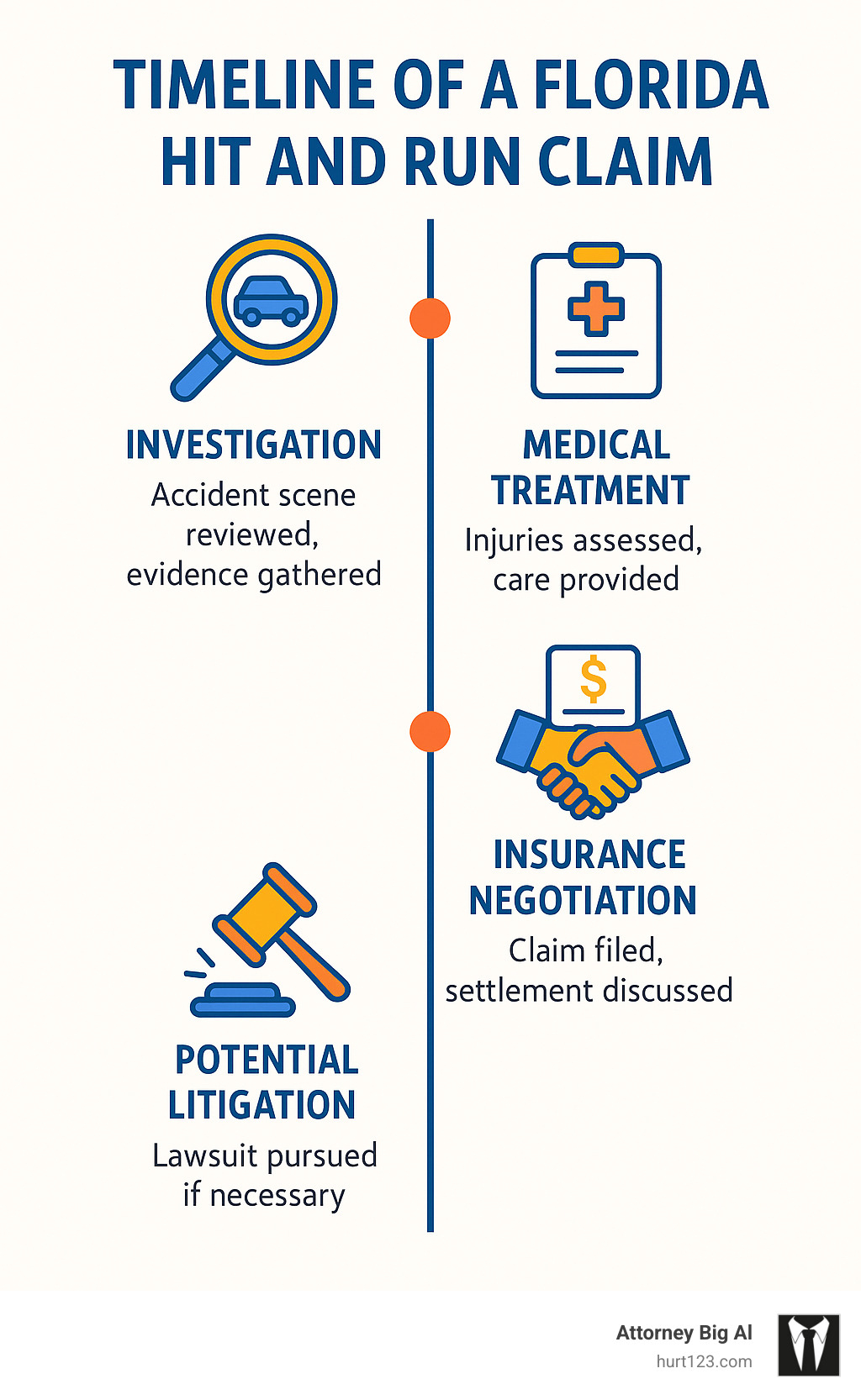
If the driver who hit you is quickly identified, your case might progress like a typical accident claim. However, if finding the responsible party requires extensive investigation—or if they’re never located—this naturally extends the timeline.
The severity of your injuries plays a major role too. We typically advise waiting until you’ve reached maximum medical improvement (MMI) before settling. This ensures we account for all your future medical needs and don’t leave money on the table by settling too early.
Insurance company cooperation significantly impacts timing as well. Some insurers process claims efficiently, while others employ frustrating delay tactics. Hit and run claims filed under uninsured motorist coverage often face particularly rigorous scrutiny.
If we can’t secure a fair settlement through negotiation, filing a lawsuit becomes necessary. While this adds months or sometimes years to the process, it’s often the only way to obtain full compensation for serious injuries.
As a general guideline, less complicated hit and run cases with moderate injuries might resolve within 6-9 months, while complex cases involving severe injuries or litigation typically take 1-3 years.
At Attorney Big Al, we understand the financial strain you’re under after an accident. We work diligently to move your claim forward as efficiently as possible while never compromising on the quality of your representation or the amount you recover. Our goal is always to secure the maximum compensation you deserve, even if that means taking more time to build the strongest possible case.
Conclusion
The aftermath of a hit and run accident can leave you feeling abandoned twice over – first by the crash itself, then by the driver who fled the scene. When you’re dealing with physical pain, emotional distress, and mounting bills, the last thing you need is to steer Florida’s complex legal system alone.
Throughout South Florida, from the busy streets of Miami to the neighborhoods of Sunrise, hit and run victims face similar challenges. But you don’t have to face them by yourself. At Attorney Big Al, our Florida hit and run lawyers stand ready to help you through this difficult time with compassion, expertise, and determination.
We’ve seen how these incidents can upend lives. A moment’s carelessness by another driver can lead to months or years of recovery, financial strain, and emotional healing. That’s why we fight so hard for our clients – because we understand what’s at stake.
The road to recovery starts with simple but crucial steps. Seek medical care immediately, even if you feel “fine” – some injuries take days to manifest. Document everything you can about the accident scene. Report the incident to police and your insurance company promptly. And perhaps most importantly, speak with a Florida hit and run lawyer before accepting any settlement offers.
Florida’s statute of limitations gives you just two years to file an injury claim – a timeline that can pass quickly when you’re focused on healing. Acting promptly helps preserve evidence and protect your legal rights.
Even if the driver who hit you is never found, you may still have options through your own insurance coverage. Our team excels at maximizing these benefits while continuing to pursue all avenues for identifying the responsible party.
The emotional impact of being left at an accident scene shouldn’t be underestimated. Beyond physical recovery, many victims experience anxiety, depression, or even PTSD. We consider these non-economic damages just as important as medical bills and lost wages when building your case.
At Attorney Big Al, we believe that hit and run victims deserve not just compensation, but closure. Whether through insurance claims or civil litigation, we’ll work tirelessly to help you rebuild your life and move forward with confidence.
Your journey to healing is personal, and so is our approach to your case. We take the time to understand your specific circumstances, concerns, and goals. Then we put our resources, experience, and passion to work for you.
If you or someone you love has been injured in a hit and run accident anywhere in Florida, we invite you to reach out for a free, no-obligation consultation. Let us handle the legal complexities while you focus on what matters most – your recovery.
Learn more about our personal injury services and how we can help you steer the aftermath of a hit and run accident.
