

Apartment Complex Injury: Critical 2025 Guide
Understanding Your Legal Rights After an Apartment Complex Injury
If you’ve suffered an apartment complex injury, you may have the legal right to seek compensation from your landlord. When a landlord’s negligence—like failing to fix broken stairs or maintain common areas—causes an injury, they can be held liable under premises liability law.
Key things to know about apartment complex injuries:
- Landlords have a legal duty to keep common areas safe (hallways, stairwells, parking lots, pools).
- You can sue for compensation if their negligence caused your injury.
- You need to prove four things: duty of care, breach of that duty, causation, and damages.
- Florida gives you 2 years to file most personal injury claims.
- You cannot be evicted for pursuing a legitimate injury claim.
Getting hurt in your apartment complex is overwhelming. You’re dealing with medical bills and pain while wondering about your legal options. The good news is that Florida law protects tenants and visitors injured by a property owner’s failure to maintain safe conditions. Whether you slipped on a wet floor, tripped on broken pavement, or were assaulted due to inadequate security, you may be entitled to compensation.
This guide walks you through the legal process, from understanding your rights to filing a lawsuit if necessary. Understanding your rights is the first step toward holding negligent property owners accountable.
What This Guide Covers
This guide explains what you need to know about apartment complex injuries in Florida:
- Premises liability law and how it applies to rental properties
- Your rights as a tenant when injured on the property
- Immediate steps to take after an injury to protect your claim
- How to seek compensation for medical bills, lost wages, and pain and suffering
- Florida-specific laws including fault rules and filing deadlines
- The legal process from initial claim to potential lawsuit
Understanding Your Rights After an Apartment Complex Injury in Florida
When you sign a lease, your landlord takes on a legal responsibility to keep you safe. If they fail in this duty and you get hurt, premises liability law protects you. You have the right to expect safe common areas, like hallways and stairwells. If these basic standards aren’t met and you suffer an apartment complex injury, the law provides options to hold your landlord accountable.

What is a Landlord’s Legal Duty of Care?
Your landlord has a legal “duty of care” toward tenants and visitors under premises liability law. This is part of the implied warranty of habitability, meaning your landlord promised a safe place to live. They are responsible for maintaining all common areas—hallways, stairwells, parking lots, and swimming pools—free from hazards. If a landlord knows about a dangerous condition, they must fix it promptly or provide clear warnings. In areas with a history of crime, they may also need to provide adequate security measures, like proper lighting and working locks. The scope of this duty depends on the property and the hazard. If you’ve been injured in the Fort Lauderdale area, our Fort Lauderdale slip and fall lawyer team understands how these duties apply.
Common Causes of Injuries and Proving Negligence
Apartment complex injuries often result from slip and fall or trip and fall accidents. Common causes include wet floors without warning signs, cracked pavement, broken stairs, loose handrails, and poor lighting. Inadequate security, such as broken locks or poor lighting in parking lots, can lead to assaults for which a landlord may be liable. Dog bites are another concern; if a landlord knows a dangerous dog is on the property and does nothing, they may share responsibility. Other hazards include defective gym equipment and swimming pool accidents.
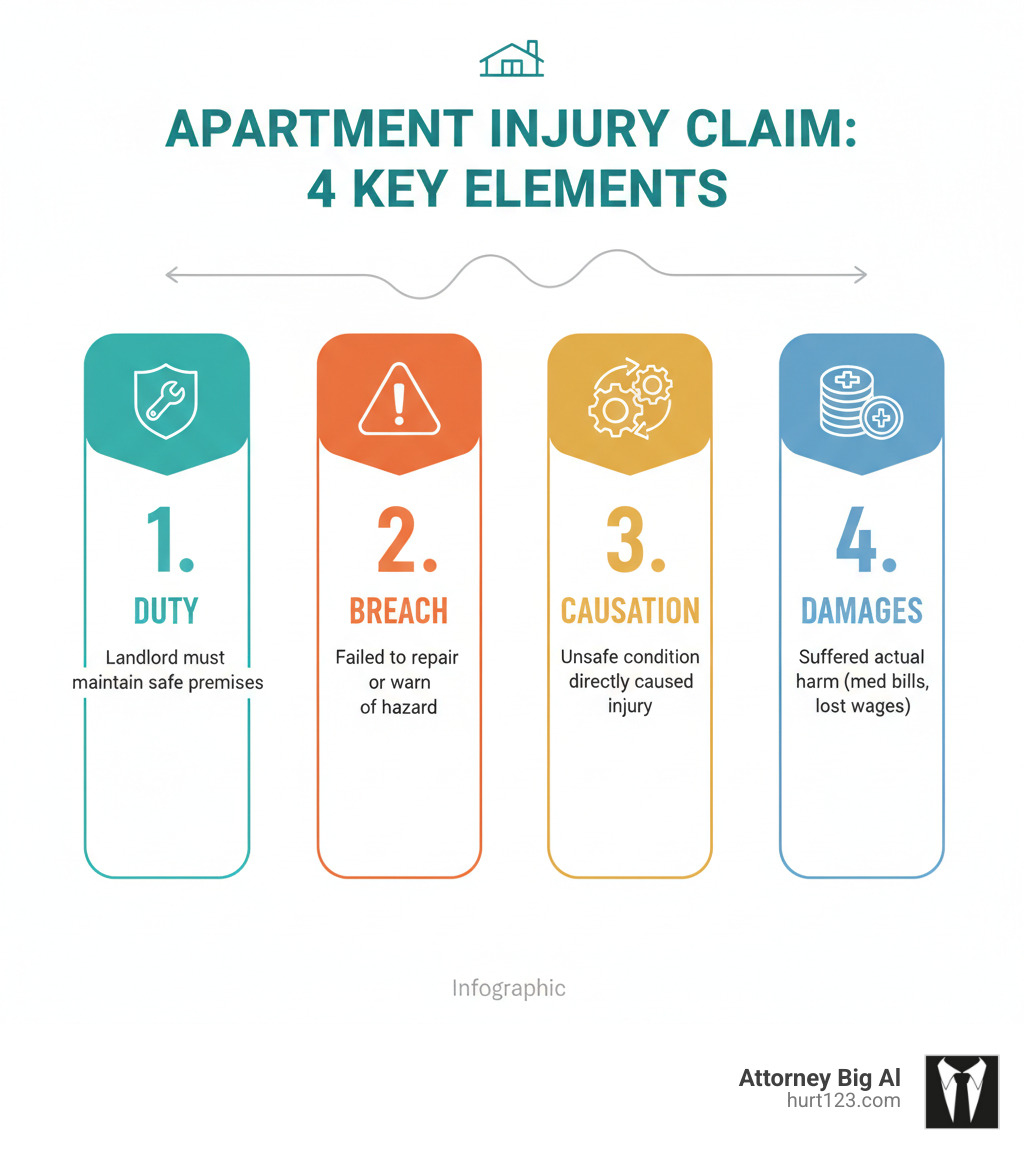
However, an injury alone isn’t enough for a claim. You must prove negligence by showing four elements:
- Duty of Care: The landlord had a duty to keep the property safe.
- Breach of Duty: They failed in that duty. This requires showing the landlord had actual notice (they knew about the hazard) or constructive notice (the hazard existed long enough that they should have known).
- Causation: The landlord’s failure directly caused your injury.
- Damages: You suffered actual harm, like medical bills or lost wages.
Evidence is critical in these cases, as seen in many Famous Premise Liability Cases.
What Steps Should You Take Immediately After an Injury?
The steps you take immediately after an apartment complex injury are crucial for your health and any legal claim.
- Seek Medical Help: Get checked by a doctor right away, even for minor injuries. This creates an official medical record. According to the Cleveland Clinic, even minor injuries warrant a medical check-up.
- Report the Incident: Inform your landlord or property manager in writing as soon as possible. Ask for a copy of any incident report they create.
- Document the Scene: Take photos and videos of the hazard that caused your injury and the surrounding area. Photograph your visible injuries as well.
- Get Witness Information: If anyone saw what happened, get their name and contact information.
- Preserve Evidence: Keep the clothes and shoes you were wearing and any damaged personal items. Save all medical bills and communications with the landlord.
- Avoid Recorded Statements: Do not give a recorded statement to the landlord’s insurance company without first speaking to a lawyer. They are trained to ask questions that can weaken your claim.
What Compensation Can You Recover for an Apartment Complex Injury?
If your landlord’s negligence caused your injury, you can recover compensation for various damages.
- Economic Damages: These are measurable costs, including current and future medical bills, lost wages, lost earning capacity, and other out-of-pocket expenses.
- Non-Economic Damages: These compensate for non-financial losses. This includes pain and suffering for physical discomfort and emotional distress for the psychological impact, such as anxiety or depression. As Harvard Health notes, not all consequences of an injury are visible. You can also be compensated for loss of enjoyment of life if the injury prevents you from participating in hobbies and daily activities.
An attorney can help calculate the full value of your claim, as insurance companies often try to undervalue these damages.
Navigating the Legal Process: Fault, Timelines, and Retaliation
Understanding Florida’s legal rules is key to a successful apartment complex injury claim.
- Comparative Fault: Florida uses a “modified comparative negligence” system. You can still recover damages even if you were partially at fault, but your compensation will be reduced by your percentage of fault. For example, if you are found 20% at fault for a $100,000 claim, you would receive $80,000.
- Statute of Limitations: This is a critical deadline. In Florida, you generally have two years from the date of injury to file a lawsuit. If you miss this deadline, you lose your right to sue. It’s important to understand Why You May Need a Trip and Fall Lawyer in Florida to ensure all deadlines are met.
- Retaliation and Waivers: It is illegal for a landlord to evict you or reduce services in retaliation for filing a legitimate injury claim. Also, don’t assume a liability waiver in your lease prevents you from suing. Courts often find these waivers unenforceable, especially in cases of gross negligence. Always consult a lawyer to understand your rights.
How a Personal Injury Lawyer Can Help Your Claim
When you’re dealing with an apartment complex injury, managing the legal process on top of your recovery can feel overwhelming. A personal injury lawyer can handle the complexities of your case while you focus on healing.
At Attorney Big Al, we have the resources and dedicated team to stand up to major insurance companies and fight for the compensation you deserve. We handle everything so you can focus on getting better.

The Role of an Attorney in Your Case
Think of us as your advocate, investigator, and negotiator. From the moment you reach out, we get to work building the strongest possible case for you. An attorney will:
- Investigate the Incident: We gather crucial evidence, including photos, maintenance records, and witness statements, to prove the landlord knew or should have known about the hazard.
- Identify All Liable Parties: Your landlord may not be the only one at fault. We investigate if maintenance companies, security firms, or other third parties share responsibility.
- Calculate Your Full Damages: We look beyond current medical bills to account for future medical needs, lost earning capacity, and the real pain and suffering you’ve endured.
- Negotiate with Insurance Companies: Insurers aim to pay as little as possible. We handle all communications, counter lowball offers, and protect you from tactics designed to weaken your claim.
- Represent You in Court: If a fair settlement isn’t reached, we are prepared to file a lawsuit and take your case to trial, presenting a compelling argument to a judge and jury.
We understand the nuances of Florida’s premises liability law and have handled countless cases involving injuries at apartment complexes. For more information, visit our Premises Liability Lawyer page.
If you’ve suffered an apartment complex injury in Fort Lauderdale, Miami, Hollywood, Boca Raton, or anywhere in Florida, don’t wait. The sooner you contact us, the sooner we can start building your case. We offer free consultations.
Call us now for a free consultation. We have offices throughout South Florida, including Fort Lauderdale:

You deserve compensation for what you’ve been through. Let Attorney Big Al fight for you.
Conclusion
An apartment complex injury can disrupt your life with pain, medical bills, and lost time from work. However, Florida law holds landlords responsible for maintaining safe properties. When they fail to fix hazards like broken stairs or provide adequate security, they can be held accountable for the harm caused.
Navigating the legal process alone is challenging, especially when facing insurance companies and property owners. Having a dedicated advocate makes a significant difference. At Attorney Big Al, we handle the legal complexities so you can focus on recovery. We investigate your claim, gather evidence, and negotiate aggressively for the compensation you deserve. If necessary, we are prepared to take your case to court.
We serve communities throughout South Florida, including Fort Lauderdale, Miami, Boca Raton, and Hollywood. Don’t let a preventable injury control your future. You have rights and options.
Contact us today to discuss your apartment complex injury case. The consultation is free, and we’re here to help you move forward.
