

Medical malpractice claims Florida: Ultimate Justice 2025
Why Understanding Medical Malpractice Claims in Miami Is Critical
Medical malpractice claims Florida follow a complex legal process that differs from other personal injury cases. If a healthcare provider’s negligence caused you harm, you need to understand the specific requirements and timelines that apply.
Quick Overview: The Florida Medical Malpractice Claims Process
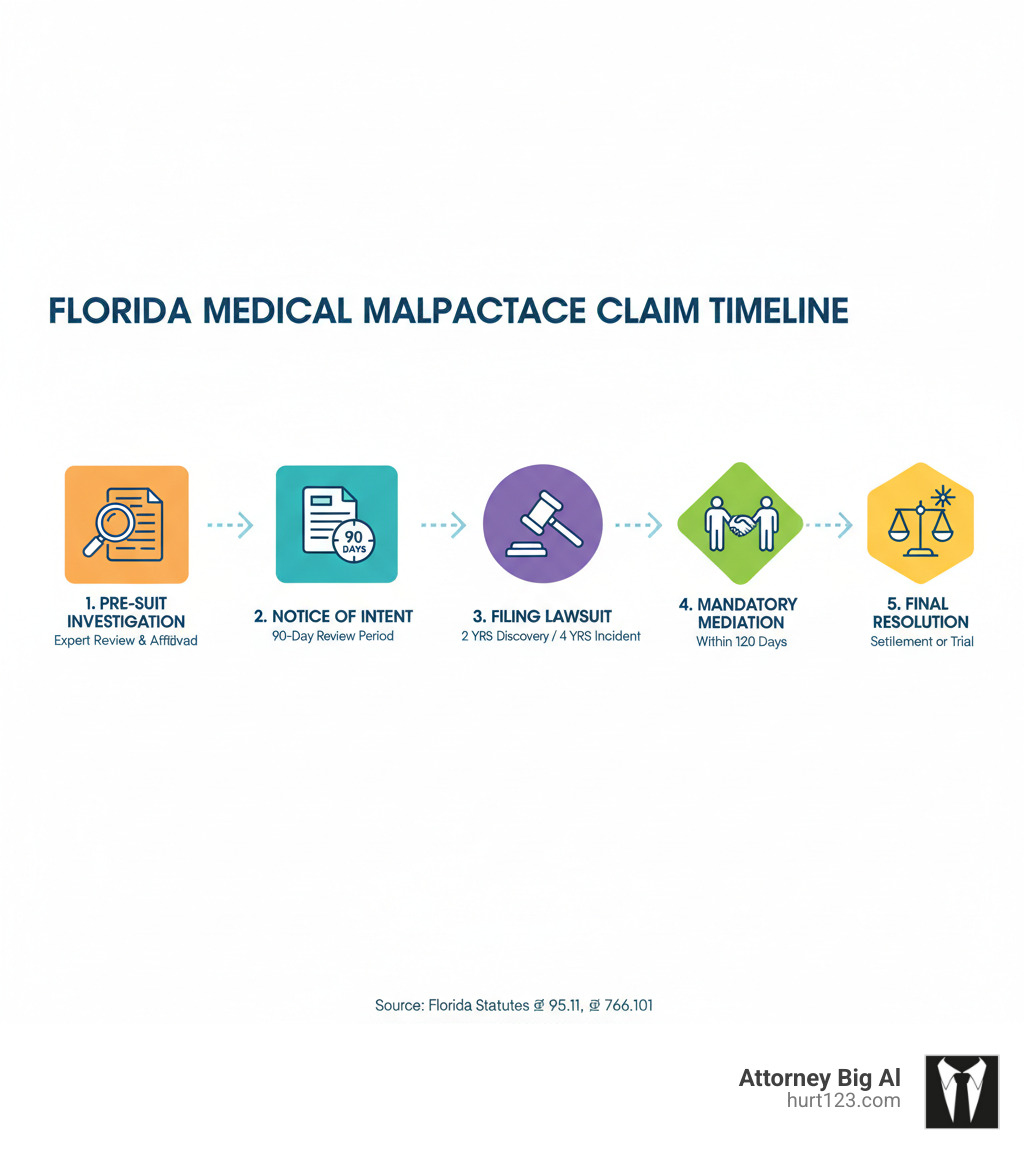
- Conduct Pre-Suit Investigation – Hire an attorney and obtain a medical professional’s opinion confirming negligence.
- Serve Notice of Intent – Notify the healthcare provider of your intent to sue (triggers a 90-day review period).
- Complete 90-Day Investigation – Allow the provider’s insurer to review your claim.
- File Your Lawsuit – Must be done within 2 years of finding the injury (but no more than 4 years from the incident).
- Attend Mandatory Mediation – Required within 120 days of filing suit.
- Reach Settlement or Go to Trial – Resolve through negotiation or court proceedings.
Florida law requires medical malpractice victims to complete specific legal steps before filing a lawsuit. You must notify the doctor or facility of your intent to sue and provide a medical professional’s affidavit confirming negligence. This notice starts a mandatory 90-day period where both sides investigate the claim.
The timeline is critical. Under Florida Statutes § 95.11, you generally have two years from finding your injury to file a claim, but no more than four years from when the negligent act occurred. Missing these deadlines can permanently bar your right to compensation.
Malpractice cases in Florida also require witnesses who are qualified medical professionals. They must actively practice in the same specialty as the provider you’re suing and conduct a complete review of your medical records before signing an affidavit supporting your claim.
This process exists to filter out frivolous claims and encourage settlement, but it also creates barriers that make it essential to work with an attorney who understands Florida’s specific requirements from day one.
What Constitutes Medical Malpractice in Miami?
Medical malpractice is not just an undesirable outcome. To have a valid claim, there must be negligence, as defined by Florida Statute 766.102. This means a healthcare provider’s actions fell below an accepted standard of care, directly causing you harm.
The core elements we must prove in any medical malpractice claims Florida case are:
- Duty: A healthcare provider owed a professional duty of care to the patient.
- Dereliction (Breach of Duty): The provider breached that duty by failing to act as a reasonably prudent similar provider would have.
- Direct Causation: The provider’s breach of duty directly caused the patient’s injury.
- Damages: The patient suffered actual harm or losses as a result of the injury.
Florida Statute 766.102 defines negligence by the ‘prevailing professional standard of care.’ An injury alone does not create a presumption of negligence. We must prove the breach of this standard by the greater weight of evidence.
A critical component in establishing this breach is the role of medical specialists. These professionals will review your case, compare the care you received to the prevailing standard, and testify whether, in their opinion, negligence occurred and directly caused your injury. Their testimony is often the backbone of a successful claim.
Common Errors Leading to Malpractice Claims in Miami
In Miami, and across Florida, we often see medical malpractice claims Florida arise from a range of medical errors that deviate from the accepted standard of care. These errors can have devastating consequences for patients and their families.
Some of the most common types of medical errors that lead to malpractice claims include:
- Diagnostic Errors: This includes failure to diagnose, misdiagnosis, or delayed diagnosis, leading to a worsening of the patient’s condition.
- Surgical Mistakes: These are often clear-cut cases of negligence, such as performing surgery on the wrong limb, leaving surgical instruments inside a patient, or damaging surrounding tissues. A foreign object left behind is considered direct evidence of negligence under Florida law.
- Medication Errors: These can range from prescribing the wrong medication or incorrect dosage. Accountability can rest on the prescribing doctor, the pharmacist, or a nurse.
- Anesthesia Errors: Mistakes made by an anesthesiologist, such as administering an improper dose or failing to monitor a patient’s vital signs, can lead to severe brain damage or death.
- Birth Injuries: Negligence during childbirth can result in serious injuries to the mother or baby. This can include a delayed C-section when necessary or improper use of delivery tools, leading to conditions like cerebral palsy.
- Failure to Treat/Insufficient Aftercare: This occurs when a provider fails to give appropriate medical attention for a diagnosed condition or neglects to provide adequate post-operative care, leading to complications.
If you or a loved one in Miami has suffered due to any of these errors, understanding your legal options is paramount.
The Key Steps for Medical Malpractice Claims in Hollywood, FL

When you’re dealing with medical malpractice claims Florida, you’re entering territory that’s quite different from other personal injury cases. Florida law has a specific roadmap you must follow, with mandatory stops and strict deadlines.
These requirements exist to encourage early settlement and filter out claims that lack substance. However, they also create significant barriers for someone trying to steer this process alone. That’s why having a legal team who knows these rules makes all the difference.
The process involves a pre-suit investigation, serving formal notice to the healthcare provider, a mandatory 90-day review period, and then either reaching a settlement or filing your lawsuit. Each step has its own requirements, and missing one can derail your claim.
We walk our clients through each phase, making sure nothing falls through the cracks. In medical malpractice cases, the procedural details matter just as much as the facts of what happened to you.
Critical First Steps: Florida’s Mandatory Pre-Suit Process in Boca Raton
Here’s something that surprises most people: you can’t just file a medical malpractice lawsuit in Florida. The law requires you to complete a detailed investigation and notify the healthcare provider before you ever set foot in a courthouse. This pre-suit process is governed by Florida’s pre-suit investigation requirements, and it’s mandatory.
First, we conduct a thorough pre-suit investigation to determine if there are reasonable grounds to believe medical negligence occurred. To do this, we need a qualified medical professional in a similar specialty to review your case and sign a corroborating medical affidavit. In this sworn statement, they confirm their belief that the provider’s actions fell below the accepted standard of care and directly caused your injury. Without this affidavit, your claim cannot move forward.
Once we have this affidavit, we serve a Notice of Intent to initiate litigation. This formal notice is delivered to each prospective defendant—whether a doctor, hospital, or other facility—through verifiable mail.
This notice triggers the 90-day investigation period. During these 90 days, the healthcare provider and their insurance company conduct their own review. No lawsuit can be filed during this mandatory waiting period. The idea is to give both sides a chance to investigate and potentially reach a settlement without going to court. We can’t proceed to filing a lawsuit until this 90-day window closes.
In Boca Raton and throughout Florida, this pre-suit process is non-negotiable. It’s one of the reasons why having a legal team from day one is so important—we can get this process started immediately, ensuring you don’t lose precious time.
Understanding the Statute of Limitations for Florida Medical Malpractice Claims in Hollywood
Let’s talk about deadlines, because in medical malpractice claims Florida, timing can make or break your case. The statute of limitations sets a legal deadline for filing your lawsuit. Miss this deadline—even by a single day—and you lose your right to seek compensation forever.

Under Florida Statutes § 95.11, Florida uses the two-year rule. You generally have two years from the date you finded—or reasonably should have finded—your injury and the reasonable possibility that medical negligence caused it. This is known as the findy rule.
Florida also imposes the four-year statute of repose. This is an absolute deadline that runs from the date the negligent act occurred, regardless of when you finded the injury. You generally cannot file a lawsuit more than four years after the negligence happened.
An important exception exists if a provider used fraud, concealment, or intentional misrepresentation to hide their negligence. This can extend the statute of repose to seven years from the date of the act, but seven years is the absolute maximum.
Mandatory 90-day pre-suit investigation period? Filing your Notice of Intent tolls (temporarily pauses) the statute of limitations. The clock stops ticking during those 90 days.
Once the 90-day period ends, you have either 60 days or the remainder of your original statute of limitations period (whichever is longer) to file your lawsuit. These overlapping timelines can get confusing. In Hollywood and throughout South Florida, we see people who waited too long to seek legal help. That’s why we encourage anyone who suspects medical negligence to reach out immediately.
From Evidence to Resolution in Fort Lauderdale

Once you’ve steerd Florida’s pre-suit requirements, the work of building your case begins. In Fort Lauderdale, we’ve learned that success in medical malpractice claims Florida comes down to gathering solid evidence, identifying everyone who should be held accountable, and making smart strategic decisions about how to resolve your case.
Gathering Evidence and Determining Liability in Fort Lauderdale
Building a medical malpractice case is like assembling a complex puzzle. Your medical records form the foundation. We collect every document related to your care—doctor’s notes, hospital charts, lab results, and billing statements—to create a timeline that often reveals where things went wrong.
But records alone aren’t enough. We need qualified medical professionals to review your case. They must practice in the same or a similar specialty as the healthcare provider who harmed you. They will explain the prevailing professional standard of care, show how the defendant’s actions fell short, and establish the direct link between that failure and your injuries. Their testimony transforms complex medical concepts into language a jury can understand.
Simultaneously, we document every way this negligence has affected your life. This means tracking economic damages like medical bills and lost wages, and also capturing the non-economic toll: your pain and suffering and how your injuries have limited your life.
More than one party might share responsibility. If you received the wrong medication, the prescribing doctor, the hospital, or the pharmacist could be liable. We investigate every angle to hold all responsible parties accountable.
Once we file your lawsuit, we enter the findy phase. Both sides exchange information through written questions and depositions where witnesses testify outside of court. This process helps us gather more information and strengthen your position. For those curious about patterns, the Professional Liability Closed Claims Database provides insights into past claims, though a settlement doesn’t necessarily mean malpractice occurred.
Potential Damages and Case Outcomes: Settlement vs. Trial in Sunrise
When you pursue medical malpractice claims Florida, you are fighting for fair compensation. In Sunrise, we work to secure damages that reflect the full scope of harm you’ve suffered.
Economic damages cover your quantifiable financial losses. This includes all medical expenses (past and future), lost wages, and reduced earning capacity.
Non-economic damages address the intangible ways negligence has damaged your life. This is compensation for your physical pain, emotional distress, and your inability to enjoy activities that once brought you happiness.
Florida does not currently impose statutory caps on non-economic damages in medical malpractice cases due to Florida Supreme Court decisions. Separate limits may apply in claims against government-run facilities because of sovereign immunity rules, and punitive damages have their own statutory limits.
As your case progresses, it will move toward resolution through either settlement or trial. Florida law requires mandatory mediation before trial. This brings both sides together with a neutral third party to explore settlement possibilities. Many cases settle during or shortly after this process.
Settlement offers certainty. You know what you’re getting, you avoid the stress of a trial, and you resolve everything much faster. The tradeoff is you might receive less than a jury could potentially award.
Trial gives you your day in court. A jury hears the evidence and makes a decision. This can result in a larger award, but trials are lengthy, expensive, and the outcome is uncertain.
We walk our clients through these options carefully, explaining the strengths and weaknesses of their case. We have the financial resources to take on major insurance companies whether we’re negotiating a settlement or preparing for trial. Our commitment is to provide you with dedicated, professional service.
If medical negligence has turned your life upside down, you don’t have to face this process alone. Get help from a West Palm Beach medical malpractice lawyer today and let’s start building your path toward recovery.
