

Motorcycle accident brain injury: Essential Guide 2025
The Immediate Aftermath in Boca Raton: Understanding the Injury and Its Impact
A motorcycle accident brain injury can change your life in an instant. When you’re thrown from your bike or struck by another vehicle, your brain can suffer devastating damage that affects everything from your ability to think clearly to your personality and relationships.
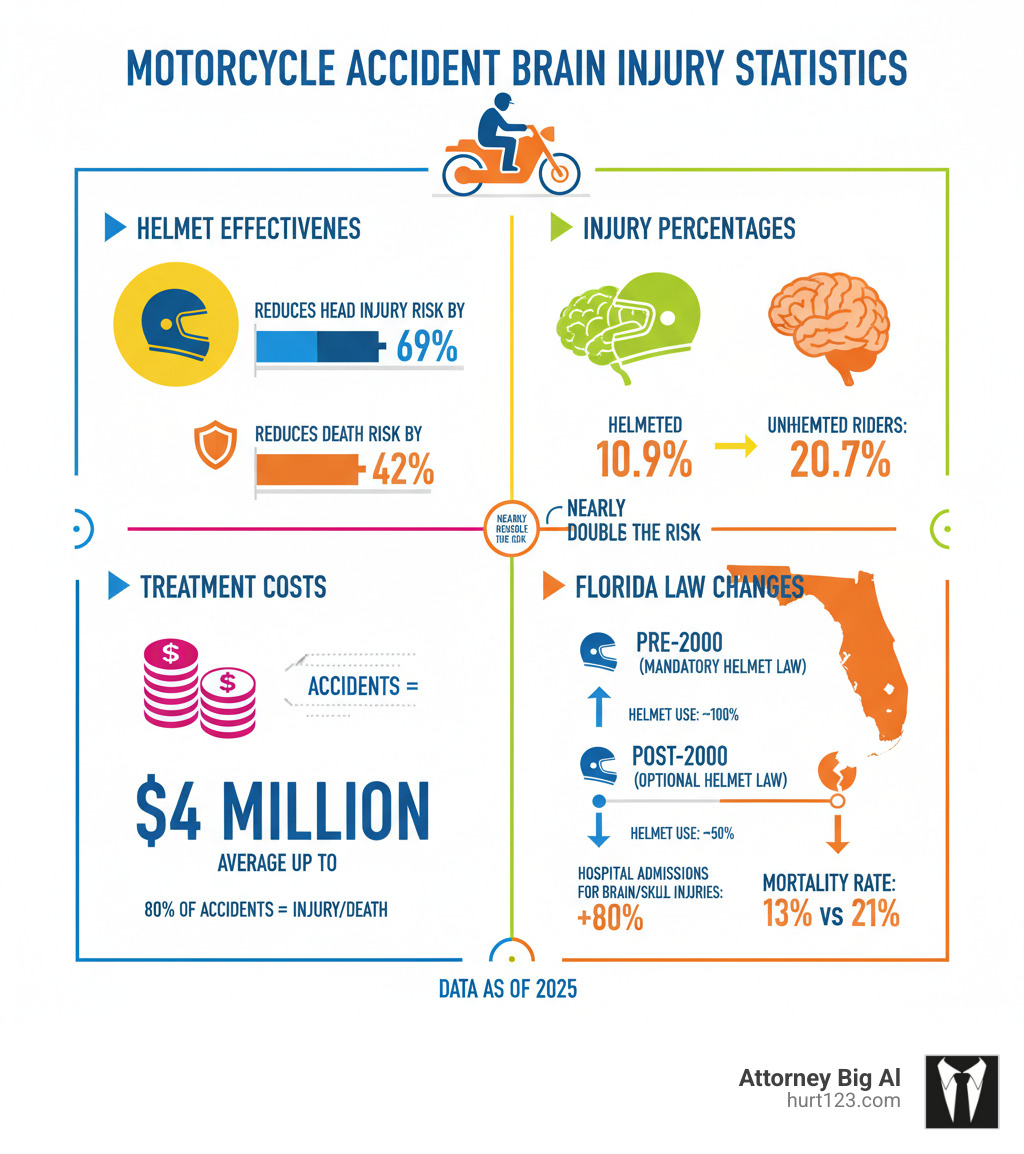
Key Facts About Motorcycle Accident Brain Injuries:
- 40-50% of all motorcycle crashes result in brain injuries
- Non-helmeted riders suffer TBIs at nearly double the rate (20.7% vs 10.9%)
- Helmets reduce head injury risk by 69% and death risk by 42%
- Average treatment costs can reach up to $4 million
- 80% of motorcycle accidents result in injury or death for the rider
Unlike car drivers who have airbags and a protective metal frame, motorcycle riders are completely exposed. When an accident happens, there’s nothing between you and the pavement. Brain injuries from these crashes don’t always show up right away; symptoms can develop days or weeks later, causing memory loss, personality changes, and difficulty with daily tasks.
The financial burden is also staggering, with families often facing hundreds of thousands of dollars in expenses from medical care and lost wages.
In Florida, the situation is especially concerning. When helmet laws became optional for riders over 21 with adequate insurance, helmet use dropped to around 50%. This change led to an 80% increase in hospital admissions for brain injuries and a significant rise in mortality.
Common Types of Traumatic Brain Injuries (TBIs) from a Crash
A motorcycle accident brain injury occurs when a blow or jolt disrupts the brain’s normal function. The extreme forces can cause the brain to collide with the skull, leading to cell damage, swelling, and bleeding. Injuries are categorized as either closed-head (skull intact) or open-head (skull penetrated).
Specific types of TBIs include:
- Concussion: Often called a “mild” TBI, it involves the brain being shaken inside the skull, disrupting its function. Even mild concussions can have lasting effects.
- Contusion: A bruise on the brain tissue that involves bleeding and swelling.
- Coup-Contrecoup Injury: A dual impact where the brain strikes one side of the skull, then rebounds to hit the opposite side.
- Hematoma: A blood clot that forms and puts pressure on the brain (e.g., epidural or subdural). These can be life-threatening if not treated quickly.
- Diffuse Axonal Injury (DAI): One of the most severe TBIs, where widespread tearing of nerve fibers occurs from rapid brain movement, often resulting in a coma.
Secondary brain injuries, such as swelling and continued bleeding, can occur days after the initial trauma, making vigilant monitoring crucial.

Recognizing Immediate and Long-Term Symptoms
Recognizing the signs of a motorcycle accident brain injury is critical, as symptoms can be delayed. It’s vital to seek immediate medical attention after any crash. Symptoms vary but generally fall into physical, cognitive, and emotional categories.
Common TBI symptoms to watch for:
- Headaches: Persistent or worsening.
- Dizziness: Vertigo or a sense of imbalance.
- Memory loss: Difficulty remembering new or past events.
- Confusion: Disorientation or feeling “foggy.”
- Mood swings: Irritability, anxiety, or depression.
- Sleep issues: Insomnia or excessive fatigue.
- Nausea and Vomiting
- Vision Problems: Blurry vision or sensitivity to light.
- Speech Difficulties: Slurred speech or trouble finding words.
- Changes in Senses: Sensitivity to noise or loss of taste/smell.
- Weakness or Numbness in limbs.
- Coordination Problems
- Loss of Consciousness
- Seizures
Long-term complications can include chronic pain, persistent cognitive impairments, emotional changes, and motor deficits, significantly impacting daily life and relationships.
How Helmets and Florida Law Affect Injury Severity
The single most effective way to prevent or minimize a motorcycle accident brain injury is to wear a helmet. Studies consistently show that helmets reduce the risk of head injury by 69% and the risk of death by 42%.

In Florida, riders younger than 21 must wear a helmet. Riders 21 or older may ride without one if they carry at least $10,000 in medical insurance. While legally optional for some, wearing a helmet is always the safest choice.
Even if you were legally riding without a helmet, it can still affect your personal injury claim. Under Florida’s comparative negligence doctrine, an insurance company can argue that your injuries would have been less severe had you worn a helmet. This could reduce your recoverable damages by the percentage of fault assigned to you, making these cases particularly complex.
The Path Forward in Fort Lauderdale: Medical, Financial, and Legal Recovery
After a motorcycle accident brain injury, the path to recovery is complex, involving medical care, financial pressures, and legal challenges. Understanding the steps ahead can help you steer this difficult time.

The road to recovery isn’t just about healing your brain—it’s about rebuilding your life. This means getting the right medical care, protecting your financial future, and holding those responsible accountable.
Medical Treatments and Rehabilitation Strategies
After a motorcycle accident brain injury, emergency care focuses on stabilizing the patient and preventing further brain damage. CT scans or MRIs are used to assess the injury’s severity. While a mild concussion may only require rest and monitoring, moderate to severe injuries can necessitate surgery to relieve pressure, remove blood clots, or repair skull fractures.
Long-term recovery involves intensive rehabilitation. Physical therapy helps regain strength, occupational therapy assists with daily tasks, and speech therapy addresses communication issues. Neuropsychology sessions focus on rebuilding cognitive skills like memory and attention. Recovery is a long process, and many patients face lasting challenges. Resources like Information on TBI recovery can help you understand what to expect.
Building Your Case: Evidence for a Motorcycle Accident Brain Injury Claim
Proving the impact of a brain injury requires extensive documentation, as these injuries are often invisible. Insurance companies will look for any reason to minimize your claim. Key evidence includes:
- Emergency room notes and all subsequent medical records.
- Reports from rehabilitation therapists (physical, occupational, etc.).
- The official police report.
- Photos of the accident scene, vehicle damage, and your helmet.
- Statements from any witnesses.
- Testimony from medical and financial specialists to explain the long-term consequences and costs of your injury.
Thorough documentation is vital, especially since many brain injury symptoms have a delayed onset.
Seeking Fair Compensation in Boca Raton
A motorcycle accident brain injury creates a massive financial burden. Fair compensation should cover all your damages, not just the initial bills.
Economic damages have a clear cost and include:
- Current and future medical bills
- Lost wages and reduced earning capacity
- Costs for assistive devices or home modifications
Non-economic damages compensate for intangible losses like:
- Pain and suffering
- Emotional distress
- Loss of enjoyment of life
- Loss of consortium (impact on family relationships)
In Florida, the comparative fault rule means your compensation can be reduced if you are found partially at fault. Insurance companies often use this, especially regarding helmet use, to lower payouts. They are businesses focused on their bottom line and may make low settlement offers early on, hoping you’ll accept before understanding the true cost of your brain injury. This is why having experienced legal representation is so important.
How a Boca Raton Motorcycle Accident Lawyer Can Help
When you’re recovering from a motorcycle accident brain injury, the last thing you need is a legal battle. Your world is upside down, and you’re facing a mountain of bills. That’s when you need an advocate in your corner. At Attorney Big Al, we’ve guided countless families in Boca Raton through this process.

During a free consultation, we listen to your story and review your medical records and accident reports to help you understand your legal options. There’s no pressure and no upfront cost.
If you choose to work with us, we take the burden off your shoulders so you can focus on healing. Our team immediately starts gathering crucial evidence, tracking down witnesses, and coordinating with your medical team to document every aspect of your injury. We understand that brain injury symptoms can appear weeks after an accident and work to build a comprehensive case that reflects your long-term needs.
Insurance companies will try to downplay your injuries or use Florida’s helmet and comparative fault laws to pay you less. We know their tactics and counter them by fighting for the full cost of your injury, including future medical care, lost wages, and your pain and suffering.
While many cases settle, we are always prepared to take your case to trial if an insurance company refuses to offer fair compensation. Our litigation team has the resources to go up against major insurance companies and present your case to a jury.
A brain injury from a motorcycle accident is devastating, but it doesn’t have to define your future. With the right legal team fighting for you, you can secure the resources you need for proper treatment and rehabilitation.
If you or someone you love has suffered a motorcycle accident brain injury in Boca Raton, don’t wait to get help. The sooner we can start working on your case, the better we can protect your rights.
More info about our services is available on our website, or you can call us directly for your free consultation. Let us help you get back on the road to recovery.
