
Slip and Fall Accidents Lawsuits: Win in 2025
Understanding the Basics of a Slip and Fall Claim
A slip and fall accident can happen in an instant, but the consequences can be long-lasting. Slip and fall accidents lawsuits are personal injury claims filed when someone is injured on another person’s property due to a hazardous condition. These cases fall under premises liability law, which establishes a property owner’s legal obligation, or “duty of care,” to keep their property reasonably safe for visitors.
These incidents are alarmingly common. The National Floor Safety Institute reports that slip and fall accidents cause over a million emergency room visits in the U.S. each year. For older adults, the risk is even greater; the CDC notes that falls are the leading cause of injury-related death for those over 65. These aren’t minor tumbles—they can lead to broken bones, head trauma, and spinal cord damage.
Common causes of these accidents often include:
- Wet floors from spills or cleaning without proper warning signs.
- Uneven surfaces like cracked sidewalks, torn carpets, or potholes.
- Poor lighting in stairwells, hallways, or parking lots.
- Clutter, debris, or merchandise blocking walkways.
- Unaddressed ice and snow on entrances or walkways.
Property owners must regularly inspect their premises, fix dangerous conditions, or provide clear warnings about potential hazards. If they fail in this duty and you are injured as a result, you may have grounds for a lawsuit to recover damages like medical bills, lost wages, and pain and suffering. In Florida, the time limit to file such a claim is generally two years.
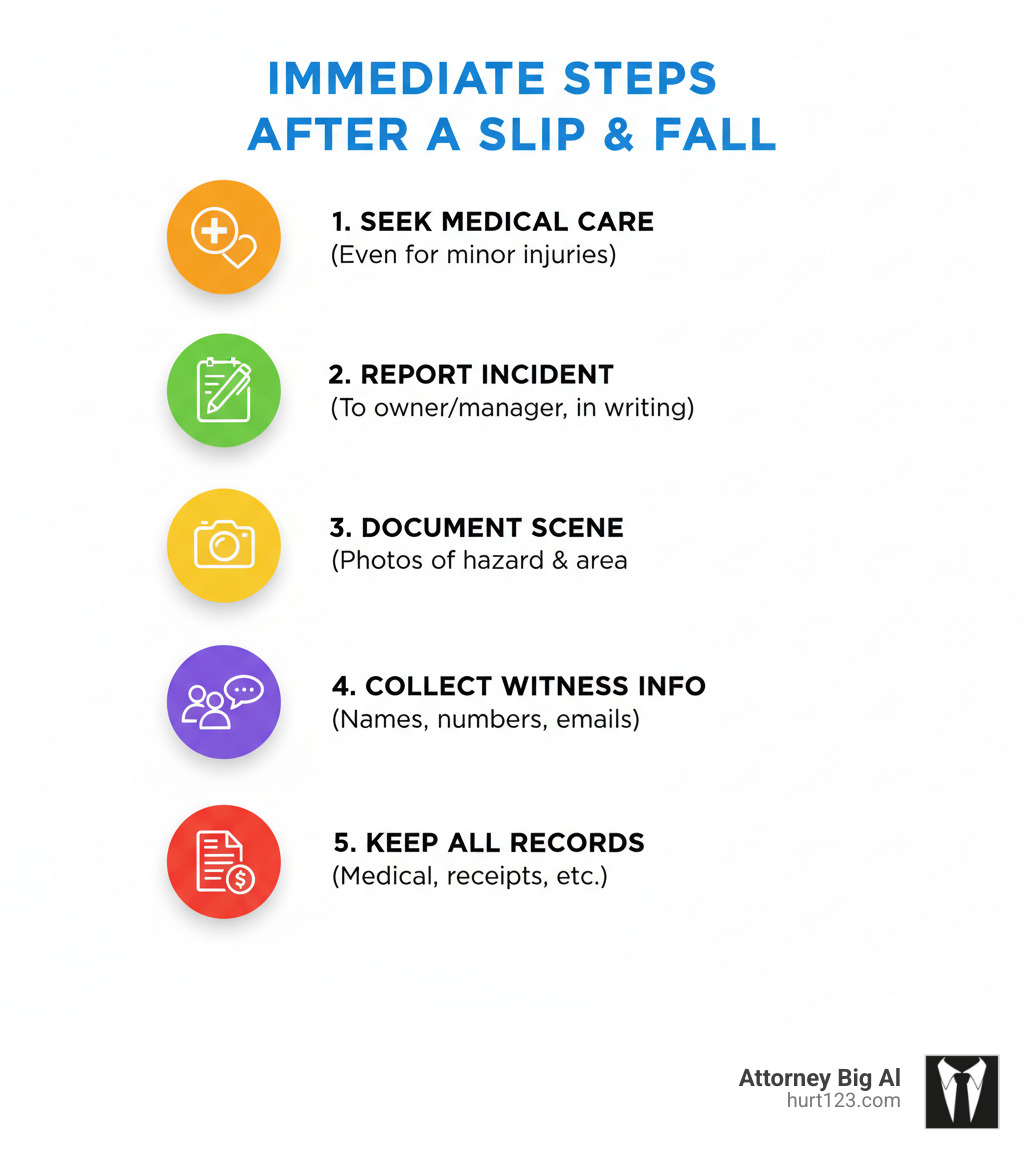
If you find yourself in this situation, the immediate steps you take are crucial. The infographic above outlines the vital first actions: seek medical attention, report the incident, document everything, and gather witness information. These steps are the foundation for any potential legal action.
Building Your Case for Slip and Fall Accidents Lawsuits

Building a strong foundation for slip and fall accidents lawsuits requires proving the property owner was negligent and that their negligence caused your injuries. Insurance companies often try to minimize payouts, making a solid, evidence-based case essential. For more on this, see our guide on Why You May Need a Trip and Fall Lawyer in Florida.
Proving Negligence in a Fort Lauderdale Slip and Fall Case
In a Fort Lauderdale slip and fall accidents lawsuit, proving negligence is the core of your claim. You must show the property owner failed in their responsibility to keep you safe. This involves establishing four key elements:
- Duty: The property owner had a legal duty to maintain a safe environment. This duty varies based on your status as a visitor. An invitee (like a store customer) is owed the highest level of care, requiring regular inspections for hazards. A licensee (a social guest) must be warned of known dangers. A trespasser is owed the least protection, though owners cannot intentionally cause harm.
- Breach: The owner breached their duty. This could mean they created the hazard, knew about it and did nothing, or should have finded it through reasonable inspection. Proving the owner had actual notice (knew about the specific hazard) or constructive notice (the hazard existed long enough that they should have known) is critical.
- Causation: The owner’s breach of duty directly caused your fall and subsequent injuries.
- Damages: You suffered real, measurable losses, such as medical bills, lost income, and pain and suffering.
Property owners will often defend themselves by claiming the danger was open and obvious and you should have avoided it, or that your own carelessness contributed to the fall. This is why collecting strong evidence is vital. Immediately after an accident, gather photos or videos of the scene, witness contact information, and file an incident report. Your medical records will also be crucial to link your injuries directly to the fall.
For specific guidance on what to do immediately after an incident at a business, our article What Should I Do If I Slip Hurt Myself at a Restaurant walks you through the important first steps.
How Fault is Determined in Florida Slip and Fall Accidents Lawsuits

If you’re worried about being partially at fault for your fall, Florida’s laws offer some relief. The state follows a pure comparative negligence rule. This means you can still recover damages in slip and fall accidents lawsuits even if you bear some responsibility for the accident. Your total compensation will simply be reduced by your percentage of fault.
For example, if you were awarded $50,000 in damages but found to be 20% at fault for being distracted, you could still recover $40,000 (80% of the total). This is a much fairer system than in states where being even 1% at fault can prevent you from recovering anything.
Because of this rule, property owners and their insurers will try to shift as much blame onto you as possible. They will scrutinize your actions, what you were wearing, and whether you were in a restricted area. Strong evidence, like photos and witness statements, is your best tool to counter these arguments and establish the correct proportion of fault. For more insights into specific hazard situations, you can read our article on Slip Fall Parking Lot.
Calculating Recoverable Damages in a Miami Claim
In Miami slip and fall accidents lawsuits, the compensation you can recover, known as damages, is divided into two main categories.
Economic damages are tangible financial losses that can be proven with bills and receipts. They include:
- Medical Expenses: All costs from the ambulance ride to ongoing physical therapy.
- Lost Wages: Income missed while you were unable to work.
- Loss of Future Earning Capacity: If the injury impacts your long-term ability to earn money.
- Out-of-Pocket Costs: Expenses like transportation to appointments or home modifications.
Non-economic damages compensate for intangible, personal losses that are harder to quantify but just as significant:
- Pain and Suffering: For the physical pain and discomfort from your injuries.
- Emotional Distress: For anxiety, depression, and other psychological impacts.
- Loss of Enjoyment of Life: If injuries prevent you from participating in hobbies and activities.
- Disfigurement or Permanent Impairment: For scarring or long-term disability.
Thorough documentation is essential for proving all damages. Keep every medical bill, receipt, and pay stub. A personal journal detailing how the injuries affect your daily life can also be powerful evidence for non-economic damages.
These injuries can be especially severe for older adults. As noted in CDC data on older adult falls, falls are a leading cause of injury-related death among seniors and can lead to life-altering complications. Our Miami Slip and Fall Lawyer team knows how to value these claims to pursue the full compensation you deserve.
Navigating the Legal Journey for Slip and Fall Accidents Lawsuits
A key decision in slip and fall accidents lawsuits is whether to settle out of court or go to trial. Each path has distinct advantages and disadvantages.
| Aspect | Settling Out of Court | Going to Trial |
|---|---|---|
| Time | Faster resolution (months to a year) | Can take several years |
| Cost | Lower legal fees and expenses | Higher litigation costs |
| Certainty | Guaranteed, negotiated outcome | Uncertain jury verdict |
| Privacy | Details remain confidential | Becomes public record |
| Recovery | Limited to settlement amount | Potential for larger award |
| Stress | Less emotionally taxing | Can be very stressful |
The legal process generally follows these steps:
- Investigation: We gather evidence to build a strong case.
- Demand and Negotiation: We send a demand letter to the insurer and negotiate for a fair settlement. Most cases are resolved at this stage.
- Filing a Lawsuit: If negotiations fail, a lawsuit is filed to begin the formal court process.
- Findy: Both sides exchange information through written questions and depositions (sworn testimony).
- Mediation and Trial: Many cases settle during mediation, where a neutral party facilitates a resolution. If not, the case proceeds to trial.
A critical deadline is Florida’s statute of limitations, which generally gives you only two years from the accident date to file a lawsuit. Missing this deadline can bar you from seeking compensation. Our Pembroke Pines Slip and Fall Lawyer team can guide you through this complex journey, handling the legal details while you focus on recovery.
Taking the Next Step After Your Accident in Sunrise

After a slip and fall, you may feel overwhelmed by pain, frustration, and uncertainty. Navigating slip and fall accidents lawsuits is complex, but you don’t have to do it alone.
Here are the key takeaways from this guide:
- Act Quickly: Seek medical care, report the incident, and document the scene immediately. This is essential for protecting your rights.
- Document Everything: Keep all records, photos, and witness information. This is your best defense against an insurer’s attempts to deny your claim.
- Understand Florida Law: Property owners have a duty to keep you safe, and Florida’s comparative fault rule allows you to recover compensation even if you were partially at fault.
- Mind the Deadline: Florida’s two-year statute of limitations is strict. The clock starts ticking on the day of your accident.
Taking on insurance companies by yourself is a difficult fight. They have vast resources dedicated to paying you as little as possible. At Attorney Big Al, we level the playing field. We have the financial resources to challenge major insurance companies and the dedication to handle your case while you focus on healing.
Your free consultation with our Sunrise Slip and Fall Lawyer team is the first step toward regaining control. We will listen to your story, explain your legal options clearly, and help you understand what fair compensation looks like for your case. You didn’t ask for this accident, and you shouldn’t have to bear the financial burden alone. Learn more about how a premises liability lawyer can help you and take action to get your life back on track.
