
Understanding How Injured Florida Drivers Prove a Crash With No Impact
Key Takeaways: A Florida no-contact car accident occurs when a phantom driver causes injury without touching your vehicle, making corroborating evidence essential. The strongest proof combines an official police crash report, independent witness statements, physical roadway evidence, dashcam or surveillance footage, and prompt medical records. While crash reports generally cannot be used as trial evidence under Fla. Stat. § 316.066(4), they guide your claim and link to liability coverage obligations. Because the at-fault driver is usually unidentified, your uninsured motorist coverage often becomes the primary recovery path, supported by Florida’s no-fault PIP benefits. Florida’s modified comparative negligence rules mean strong evidence establishing the phantom driver’s fault directly affects recovery, since a claimant found more than 50 percent at fault cannot collect damages.
When another vehicle forces you off the road or causes a collision without touching your car, proving what happened can be challenging. A no contact car accident occurs when a phantom driver causes injury without physical contact and often flees the scene. Recovery requires an official police crash report, independent witness statements, physical roadway evidence, dashcam or surveillance footage, and prompt medical documentation. Because the at-fault driver is frequently unidentified, this evidence becomes the backbone of any phantom vehicle claim in Florida.
If you were hurt by a driver who vanished, reach out to Attorney Big Al at 1-800-HURT-123, call 1-800-487-8123, or connect through the firm’s online case review page to discuss your next steps.
What Counts as No Contact Car Accident Evidence in Florida
The strongest no contact crash evidence combines official documentation with independent proof that a phantom vehicle caused your harm. Without paint transfer or bumper damage, insurers and courts require corroboration from neutral sources.
The most persuasive categories of corroborating evidence include:
- An official police crash report created by an investigating officer
- Statements from independent eyewitnesses who saw the phantom driver
- Physical evidence such as skid marks, debris, or vehicle positioning
- Dashcam, traffic camera, or nearby business surveillance footage
- Contemporaneous medical records connecting your injuries to the incident
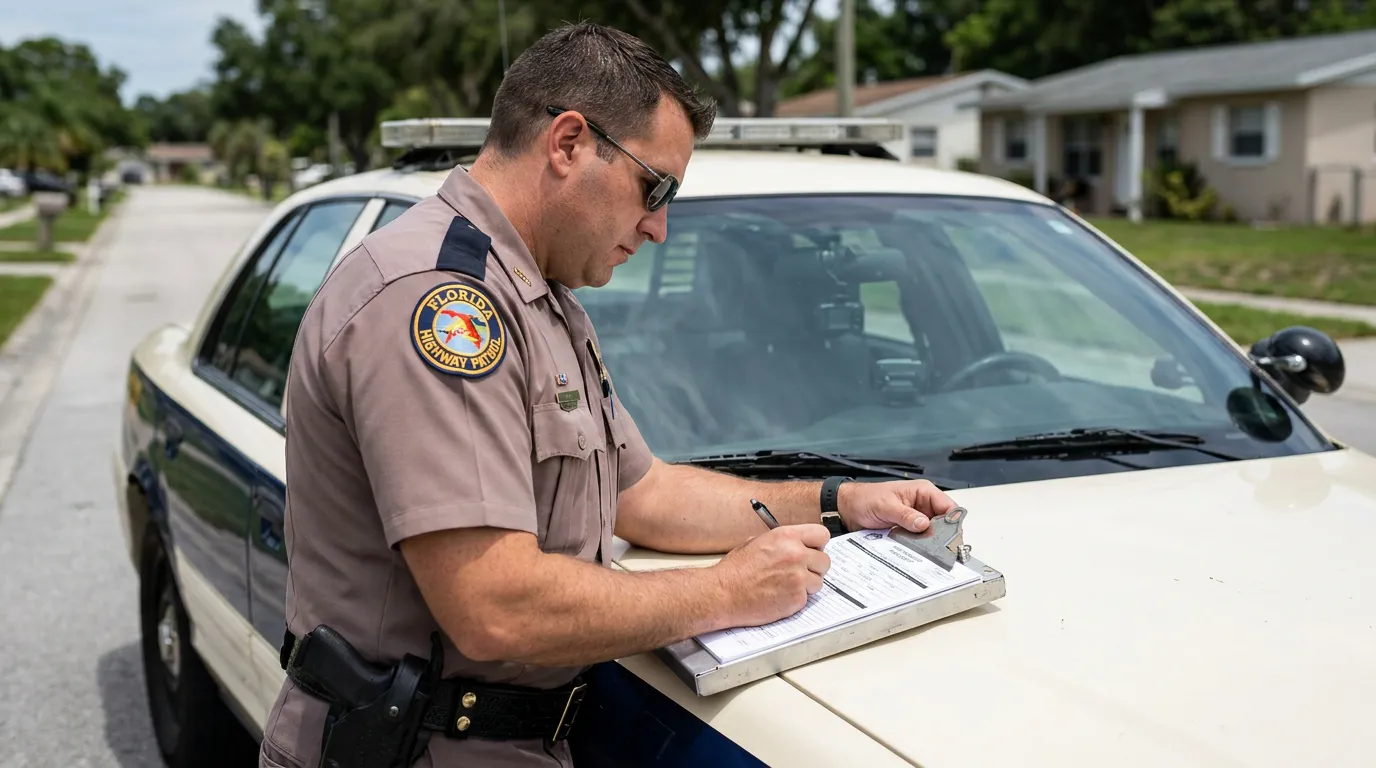
A written police report holds particular weight in Florida crash investigations. Under Fla. Stat. § 324.051(1)(a), an officer investigating a reportable crash must forward a written crash report to the department within 10 days of completing the investigation. For a no-contact victim, promptly obtaining this report creates contemporaneous documentation that corroborates the phantom driver’s role.
💡 Pro Tip: Ask the responding officer for the report number before leaving the scene so you can request a certified copy without delay.
How Crash Reports Can and Cannot Be Used
Florida law draws an important distinction between reporting a crash and using that report in court. Many injured drivers assume the report will be admitted at trial. Understanding the difference helps you gather the right supporting proof early.
Under Fla. Stat. § 316.066(4), a crash report and any statement made by a person involved to complete it may not be used as evidence in civil or criminal trials, although law enforcement officers may testify at criminal trials about such statements. This privilege does not shield an officer’s scene observations, physical evidence, or statements from independent witnesses. The report guides your claim and triggers administrative processes, but underlying witnesses, photos, and medical records carry evidentiary force. For a practical checklist, review this guide on what evidence to gather after a Florida crash.
The report can still matter outside the courtroom. Florida’s Financial Responsibility Law ties liability coverage obligations to the crash report. The Florida Highway Safety and Motor Vehicles department notes that when an at-fault driver is charged with a moving violation and injuries were noted on the crash report, Chapter 324, Florida Statutes requires the at-fault owner or driver to carry full liability coverage. This link underscores why an official crash record is central to substantiating any accident claim.
Why Uninsured Motorist Coverage Anchors a Phantom Vehicle Claim
In a no-contact case, the unidentified driver is generally treated as uninsured, making uninsured motorist coverage your primary path to recovery. Florida requires that every motor vehicle bodily injury liability policy include uninsured motorist coverage for insured persons legally entitled to recover damages from owners or operators of uninsured vehicles.
Under Fla. Stat. § 627.727(1), UM coverage must be provided unless the named insured signs a written rejection on a form approved by the office. You can review the framework governing these policies in the state’s chapter on insurance rates and contracts. Because a phantom driver leaves no insurer to pursue, your UM coverage often determines whether you achieve full recovery.
UM coverage is layered and cannot be freely stacked. Under Fla. Stat. § 627.727(8)(a)-(e), coverage on two or more vehicles generally cannot be added together for a single accident except in limited circumstances, and if you were occupying a vehicle, the available UM coverage is typically that vehicle’s coverage.
The No-Fault Backdrop and PIP Benefits
Florida is a no-fault state, so you first turn to your own personal injury protection coverage after a crash regardless of fault.
The Florida Bar explains that if you own a motor vehicle with four or more wheels, you must carry $10,000 of personal injury protection insurance and a minimum of $10,000 of property damage liability insurance, as described in its consumer guide to auto insurance. Under Fla. Stat. § 627.736, a complying policy must provide personal injury protection to the named insured and relatives residing in the same household. Under Fla. Stat. § 627.736(4)(b), PIP benefits are overdue if not paid within 30 days after the insurer receives written notice of a covered loss.
💡 Pro Tip: Report the incident to your insurer in writing quickly, since delays can complicate both PIP and UM claims even when the other driver is unknown.
Documenting Injuries and Cooperating With Your Insurer
Corroborating a no-contact crash means substantiating your injuries, not just the collision. Medical records created soon after the event help connect your harm to the phantom vehicle and reduce the risk that an insurer questions causation.
Cooperation with your insurer carries legal consequences. Under Fla. Stat. § 627.736, if a person unreasonably refuses to submit to or fails to appear at an examination, the PIP carrier is no longer liable for subsequent PIP benefits. This rule illustrates why claimants must substantiate their injuries through consistent records and reasonable participation in the claims process.
Criminal Investigations Can Strengthen Your Evidence
A fleeing driver may face serious criminal exposure, which can drive a more thorough investigation. Under Fla. Stat. § 316.1935(4)(a)-(b), aggravated fleeing or eluding that causes injury or property damage is a second-degree felony, and if it causes serious bodily injury or death it is a first-degree felony carrying a mandatory minimum sentence of three years. A parallel criminal investigation can sometimes surface witnesses, footage, or a suspect vehicle that supports your civil claim.
How Comparative Fault Shapes a No-Contact Case
Florida’s fault-apportionment system means corroborating evidence strength directly affects recovery. In a negligence action, the court enters judgment against each liable party based on that party’s percentage of fault rather than joint and several liability, under Fla. Stat. § 768.81(3).
Two features deserve close attention. To shift fault to a nonparty, a defendant must prove that nonparty’s fault by a preponderance of the evidence at trial under Fla. Stat. § 768.81(3)(a)2. Since 2023, Florida applies a modified comparative negligence standard, and under Fla. Stat. § 768.81(6), any party found greater than 50 percent at fault for their own harm may not recover damages. These rules explain why corroborating evidence that clearly establishes the phantom driver’s fault is essential to protecting your recovery.
| Evidence Type | Primary Role in a No-Contact Claim |
|---|---|
| Police crash report | Independent, contemporaneous documentation |
| Witness statements | Corroborates the phantom vehicle’s actions |
| Video footage | Objective visual proof of the maneuver |
| Medical records | Links injuries to the incident |
| UM policy details | Establishes the available recovery source |
A civil judgment can also carry consequences beyond damages. Section 324.121 authorizes suspending an at-fault party’s license when a court judgment involving a crash is rendered, provided a certified judgment and crash report are submitted to the Bureau of Motorist Compliance.
For a broader overview of how these claims are handled, explore the firm’s resources for a no contact car accident lawyer and related crash matters.
Frequently Asked Questions
-
What is a no-contact or phantom vehicle accident?
It is a crash caused by another driver who never physically touches your car and often leaves the scene. The phantom driver may have run you off the road, cut you off, or forced a sudden maneuver. Without impact, corroborating evidence becomes essential.
-
Can I recover if the other driver is never identified?
In many cases, yes, through your own uninsured motorist coverage. Under Fla. Stat. § 627.727(1), an unidentified at-fault driver is generally treated as uninsured, so UM coverage may respond. The available amount depends on your policy and stacking rules.
-
What should I do right after a hit and run in Florida?
Call law enforcement so an officer can investigate and prepare a crash report. Under Fla. Stat. § 324.051(1)(a), the officer must forward that report within the statutory timeframe. Gather witness contact information, photograph the scene, and seek medical care promptly.
-
Will my crash report be used as evidence at trial?
Generally not in the way many people expect. Under Fla. Stat. § 316.066(4), a crash report or a person’s statement made to complete it may not be used as evidence in civil or criminal trials, though an officer may testify in criminal matters. Witness testimony, footage, and medical records typically carry evidentiary weight.
-
How does comparative fault affect my phantom driver claim?
It can reduce or bar recovery depending on your assigned percentage of fault. Under Fla. Stat. § 768.81(6), a claimant found more than 50 percent at fault may not recover damages. Strong corroborating evidence helps keep fault where it belongs.
Protecting Your Recovery After a No-Contact Crash
Proving a no contact car accident in Florida depends on assembling credible, independent evidence early, from the police crash report to witness accounts, video footage, physical roadway signs, and consistent medical documentation. Because the at-fault driver is often unidentified, your uninsured motorist coverage frequently becomes the central recovery path, while Florida’s no-fault PIP system and modified comparative negligence rules shape what you must prove and what you can collect.
You do not have to face an insurer alone when a phantom driver leaves you injured. Contact Attorney Big Al at 1-800-HURT-123 today, call 1-800-487-8123 for a case review, or reach the team through the firm’s secure contact form to learn how Florida law may protect your right to recover.
