
When a Truck’s Load Becomes a Highway Hazard in Florida
Key Takeaways: A cargo securement violation truck accident occurs when a commercial vehicle’s freight drops, shifts, blows, or escapes due to improper fastening, causing a crash or injury. Florida law under Fla. Stat. § 316.520 and § 316.525 requires owners, licensees, and drivers to secure cargo, treating compliance with federal standards in 49 C.F.R. § 393.100 as satisfying those duties. Traffic citations differ from civil liability, with penalties escalating to a second-degree misdemeanor when willful violations cause serious injury or death. Responsibility may extend to the motor carrier, shipper, loading company, broker, or equipment manufacturer, with damages divided by fault percentage under Fla. Stat. § 768.81. PIP benefits under Fla. Stat. § 627.736 pay 80 percent of medical expenses and 60 percent of lost income up to $10,000, requiring initial care within 14 days, which is why serious injuries often need a separate liability claim.
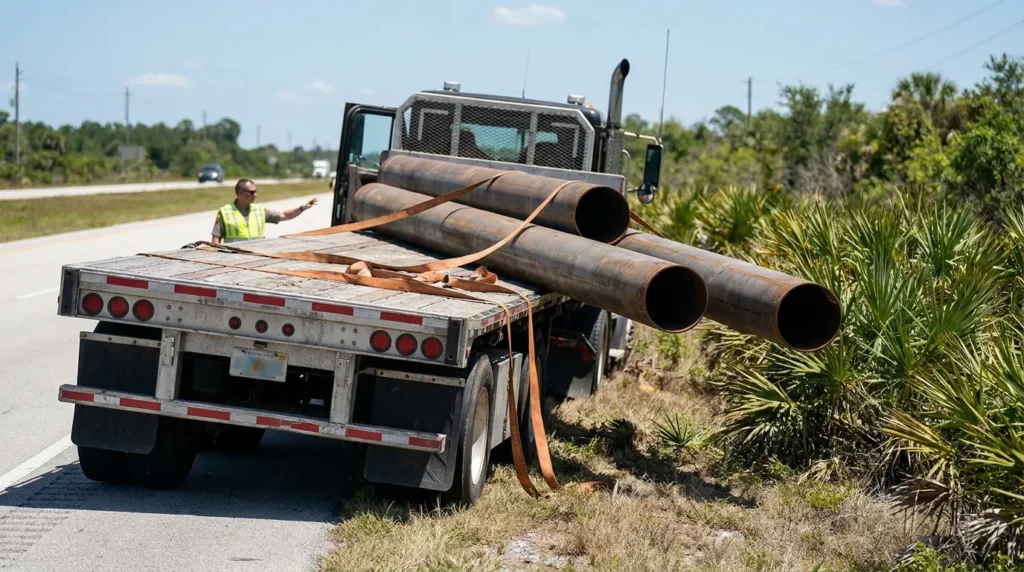
A cargo securement violation truck accident involves a commercial vehicle’s freight dropping, shifting, blowing, or escaping due to improper fastening, causing a crash or injury. Florida law under Fla. Stat. § 316.520(1) prohibits driving a vehicle unless constructed or loaded to prevent any of its load from dropping, shifting, leaking, blowing, or otherwise escaping, with limited exceptions for sand dropped for the purpose of securing traction and water or other substance sprinkled on a roadway for cleaning or maintaining the roadway. When a strap breaks on I-95, a pipe rolls off a flatbed, or a shifting pallet sends a trailer sideways, that statutory standard becomes central to the injury claim.
If you or a loved one was hurt by improperly secured freight, Attorney Big Al at 1-800-HURT-123 is ready to listen. Call 1-800-487-8123 or contact us now to discuss your options.
The Florida Statutes That Define Load Securement Duties
Florida’s cargo rules impose duties beyond the driver. Under Fla. Stat. § 316.520(2), every owner and driver must prevent materials from falling, blowing, or escaping. Securing a load with a close-fitting tarpaulin or device meeting 49 C.F.R. § 393.100 requirements satisfies this duty, linking Florida law to FMCSA cargo securement rules.
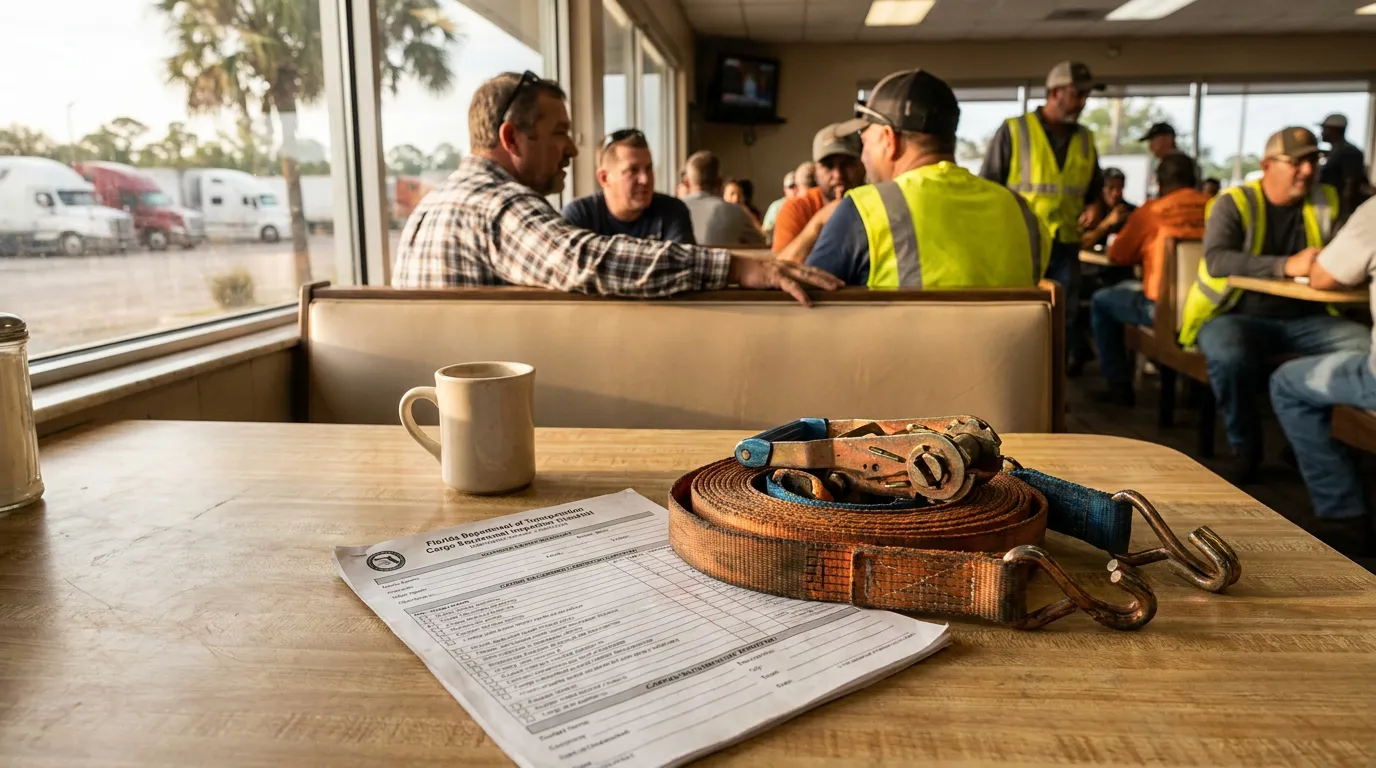
A separate statute governs fastening hardware. Fla. Stat. § 316.525(1) requires every owner, licensee, and driver of commercial vehicles to use appropriate equipment such as stanchions, lock chains, or nylon strapping to fasten loads securely. Where a carrier used a method unsuited to the freight, that choice may evidence negligence, though the statute creates no private cause of action. Review the Florida uniform traffic control laws for the complete framework.
Not every load faces every requirement. Under Fla. Stat. § 316.520(4), the tarpaulin requirement does not apply to vehicles carrying agricultural products locally from harvest sites or farms on roads with speed limits of 65 mph or less. This exemption addresses covering requirements but does not eliminate the general duty to secure loads.
How Traffic Penalties Differ From Civil Liability
A citation differs from an injury claim. Under Fla. Stat. § 316.525(2), violating load-fastening requirements is a noncriminal traffic infraction punishable as a nonmoving violation. Penalties escalate with harm: Fla. Stat. § 316.520(3)(a)-(b) treats standard violations as noncriminal infractions, while willful violations causing serious injury or death are criminal traffic offenses and second-degree misdemeanors under Fla. Stat. § 775.082 or § 775.083.
Traffic enforcement proceeds separately from civil lawsuits. A ticket does not decide a civil negligence case. Courts may treat statutory violations as evidence of negligence, but the citation itself is generally inadmissible at trial, and underlying conduct must be proven through admissible evidence.
Who May Be Responsible After an Unsecured Cargo Truck Crash
Responsibility rarely stops with the driver. Potentially responsible parties include the motor carrier, truck driver, shipper, loading company, broker, or maintenance provider. Because Fla. Stat. § 768.81(1)(c)-(d) defines "negligence action" to include strict liability, products liability, and breach of warranty, defective tie-downs, straps, or trailer components may also support manufacturer claims.
Florida generally does not apply joint and several liability. Under Fla. Stat. § 768.81(3), judgment is entered against each party based on their percentage of fault. That apportionment does not displace vicarious liability, so carriers may answer for employee driver fault. Cargo violation claims often require building proof against multiple parties separately.
Defendants frequently shift blame to nonparties. Under Fla. Stat. § 768.81(3)(a)1.-2., defendants must affirmatively plead nonparty fault, identify the nonparty per procedural rules, and prove fault by preponderance before placing them on the verdict form. Reading the Florida comparative fault statute alongside crash investigations clarifies how defenses allocate responsibility to loading companies or shippers.
Comparative Fault and Your Own Recovery
Florida uses modified comparative negligence. Fla. Stat. § 768.81(2) provides that contributory fault proportionately diminishes awards, and subsection (6) bars recovery for parties more than 50 percent at fault for their own harm in negligence actions accruing on or after March 24, 2023. Trucking defendants often argue injured motorists followed too closely or reacted improperly when cargo spilled.
These arguments are fact-driven. Skid marks, dashcam footage, electronic control module data, and witness accounts all bear on allocation. Outcomes depend on evidence developed in each case.
Why PIP Benefits Usually Are Not Enough
Florida’s no-fault system provides initial medical coverage. Fla. Stat. § 627.736 governs personal injury protection benefits for covered persons injured in motor vehicle crashes, including those caused by unsecured cargo, regardless of fault. Under Fla. Stat. § 627.736(1)(a)1., initial services and care must be rendered within 14 days after the accident for PIP medical benefits to be reimbursable.
PIP may pay only a portion of serious injury costs. Fla. Stat. § 627.736(1)(a)-(b) provides 80 percent of reasonable, medically necessary expenses and 60 percent of lost gross income, subject to a combined $10,000 limit. Benefits are further limited to $2,500 unless a qualified provider determines the injured person had an emergency medical condition. This gap is why catastrophic truck-crash injuries often require separate liability claims against trucking companies and other at-fault parties.
| Coverage Issue | What the Statute Provides |
|---|---|
| Deadline for initial care | Within 14 days of the crash, § 627.736(1)(a)1. |
| Medical benefits | 80% of reasonable, necessary expenses, up to $10,000 ($2,500 without an emergency medical condition), § 627.736(1)(a) |
| Disability benefits | 60% of lost gross income, within the same limit, § 627.736(1)(b) |
| Pre-suit demand | Written demand letter required, § 627.736(10) |
PIP disputes carry procedural requirements. Before suing for PIP benefits, claimants must serve a written pre-suit demand letter identifying the insured, claim number, providers, and itemized amounts. The insurer has 30 days to pay before suit may be filed.
💡 Pro Tip: Ask treating providers to document the crash mechanism. Notes describing a load striking your vehicle or an evasive maneuver around spilled freight may help connect injuries to the securement failure.
Building Proof in a cargo securement violation truck accident
Evidence can disappear quickly. Load manifests, bills of lading, securement inspection records, driver logs, dispatch communications, and physical straps may be discarded within weeks. Federal record-retention periods are relatively short. Prompt preservation letters to carriers, shippers, and loading facilities are critical first steps.
Key categories of proof in securement cases:
- Photographs of the load, tie-downs, and debris field before scene clearing
- Post-crash inspection reports and citations under Florida trucking regulations
- Carrier securement training materials and internal policies
- Third-party loading contracts showing who loaded and secured freight
- Electronic control module or telematics data reflecting speed, braking, and trailer sway
Requesting records early shapes the case. Our overview of the evidence needed for a truck accident claim explains how these materials fit together. Securement violations are easier to establish when documentation is captured before loss.
Timing Considerations for Filing
Civil deadlines are strict. Florida’s limitations period for general negligence actions is two years for causes accruing on or after March 24, 2023, and four years for earlier actions, with wrongful death governed by a separate two-year period. Courts interpret tolling and delayed discovery exceptions narrowly. Claims involving governmental entities face separate pre-suit notice requirements under Fla. Stat. § 768.28.
💡 Pro Tip: If a government-owned or government-contracted vehicle was involved, flag that immediately. Administrative pre-suit notice rules are distinct from filing deadlines, and missing either affects claims.
Frequently Asked Questions
1. Does a citation to the driver prove the trucking company was negligent?
Not by itself. Conduct violating Fla. Stat. § 316.520 or § 316.525 may evidence negligence, but citations are generally inadmissible, and juries evaluate duty, breach, causation, and damages based on the full record.
2. Can I recover if I was partly at fault for the crash?
Possibly. Fla. Stat. § 768.81(2) reduces recovery proportionally to a claimant’s fault, and subsection (6) bars recovery for parties more than 50 percent at fault in most negligence actions.
3. What if a warehouse, not the carrier, loaded the freight?
That entity may share responsibility. Florida allocates damages by fault percentage, so claims may need to establish negligence against loading companies separately.
4. Do I still need PIP if the truck driver was clearly at fault?
Generally yes. PIP under Fla. Stat. § 627.736 applies regardless of fault, and the 14-day treatment requirement applies without regard to who caused the collision.
5. How soon should I talk with an attorney?
As soon as practical. A Florida truck accident lawyer can send preservation demands before securement records, telematics data, and physical evidence are lost.
What These Cases Come Down To
Unsecured cargo truck crashes involve Florida traffic statutes, federal securement standards, no-fault insurance rules, and comparative fault allocation. Fla. Stat. §§ 316.520 and 316.525 establish duties, Fla. Stat. § 627.736 governs initial benefits, and Fla. Stat. § 768.81 addresses responsibility and damage division. Every case turns on its facts.
If improperly secured freight caused your injuries, Attorney Big Al at 1-800-HURT-123 is prepared to review the details. Call 1-800-487-8123 today or request your free consultation to get started.
Disclaimer: This content is for informational purposes only and is not legal advice. Every case is unique, and results may vary. Consult an attorney about your specific circumstances.
