
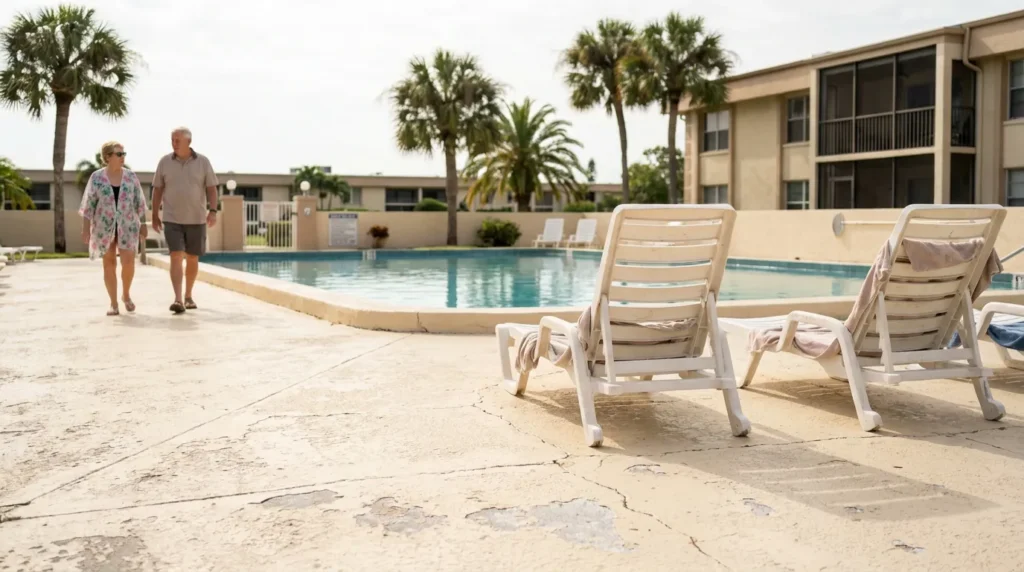
Understanding Your Rights After a Condo Pool Deck Slip
Key Takeaways: Yes, a Florida condo association can be held liable for a pool deck fall when its failure to maintain a common area causes injury. Florida’s Condominium Act, including Fla. Stat. § 718.113(1), places maintenance of common elements like pool decks on the association, establishing a duty of care. To recover, an injured person must prove the association had actual or constructive knowledge of the hazard under Fla. Stat. § 768.0755 and failed to fix it within a reasonable time. Common hazards include wet tile, algae, cracked pavers, and poor drainage. Florida’s modified comparative fault system can reduce or bar recovery, and a two-year deadline under Fla. Stat. § 95.11(4)(a) applies to negligence claims accruing on or after March 24, 2023. Acting promptly to report the fall, seek medical care, and preserve evidence gives you the strongest path to compensation.
Yes, a Florida condo association can be held liable for a pool deck fall when its failure to maintain a common area causes your injury. Pool decks are shared spaces that associations must keep reasonably safe, and when wet tile, algae, cracked pavers, or poor drainage leads to a fall, the association may face a premises liability claim. The path to recovery depends on proving the association knew or should have known about the hazard and failed to fix it in a reasonable time.
If you were hurt on a condo pool deck, Attorney Big Al at 1-800-HURT-123 is ready to listen. Call 1-800-487-8123 for a free case review or reach out through our contact page to learn how Florida law may protect your right to compensation.
How Florida Law Defines Condominium Duty of Care Florida
The foundation of any pool deck case is the legal duty the association owes to people who use its common areas. Under Florida’s condominium maintenance statute, Fla. Stat. § 718.113(1) states that "Maintenance of the common elements is the responsibility of the association," and the association "shall provide for the maintenance, repair, and replacement of the condominium property for which it bears responsibility pursuant to the declaration of condominium." Pool decks, walkways, and recreational areas generally fall within these common elements.
This statutory obligation establishes a legal standard of care. The association’s powers under Fla. Stat. § 718.111(3)(a) include the power to acquire title to property or otherwise hold, convey, lease, and mortgage association property for the use and benefit of its members. The statute also contains language about "mechanical, electrical, and plumbing elements serving an improvement or a building" in § 718.111(3)(b) in the context of the association’s authority to institute legal actions on behalf of unit owners, rather than as a standalone maintenance directive. The duty to maintain common elements such as pool decks is expressly set forth in Fla. Stat. § 718.113(1). When leadership ignores a known danger, Fla. Stat. § 718.111(1)(d) requires officers and directors to act "with the care an ordinarily prudent person in a like position would exercise under similar circumstances."
Access rights reinforce that the association controls the space and must keep it reasonably safe. Florida law guarantees under Fla. Stat. § 718.123(1) that "All common elements, common areas, and recreational facilities serving any condominium shall be available to unit owners… and their invited guests for the use intended." To understand how maintenance roles are divided, review who maintains common areas in Florida condo cases.
💡 Pro Tip: Request a copy of the declaration of condominium early. It often clarifies whether a specific area is a common element or limited common element, which affects responsibility.
Proving the Association Knew About the Hazard
The most contested issue in pool area slip and fall cases is knowledge of the dangerous condition. Florida’s transitory substance statute, Fla. Stat. § 768.0755, requires an injured person to prove that the establishment "had actual or constructive knowledge of the dangerous condition and should have taken action to remedy it." This statute technically applies to a "business establishment," but the same actual or constructive knowledge requirement generally arises under common-law premises liability for residential associations.
Constructive knowledge is often the key, proven through circumstantial evidence. You may demonstrate "that the dangerous condition existed for such a length of time that, in the exercise of ordinary care, the business establishment should have known of the condition," or "that the condition occurred with regularity and was therefore foreseeable." Proof such as recurring algae growth, repeated drainage failures, or witness accounts that a puddle sat untouched for hours can carry significant weight.
Evidence That Tends to Strengthen a Claim
Strong documentation separates a provable case from a difficult one. The following evidence often establishes what the association knew and when:
- Time-stamped photos and video of the hazard and surrounding area
- The official incident report filed with the association or property manager
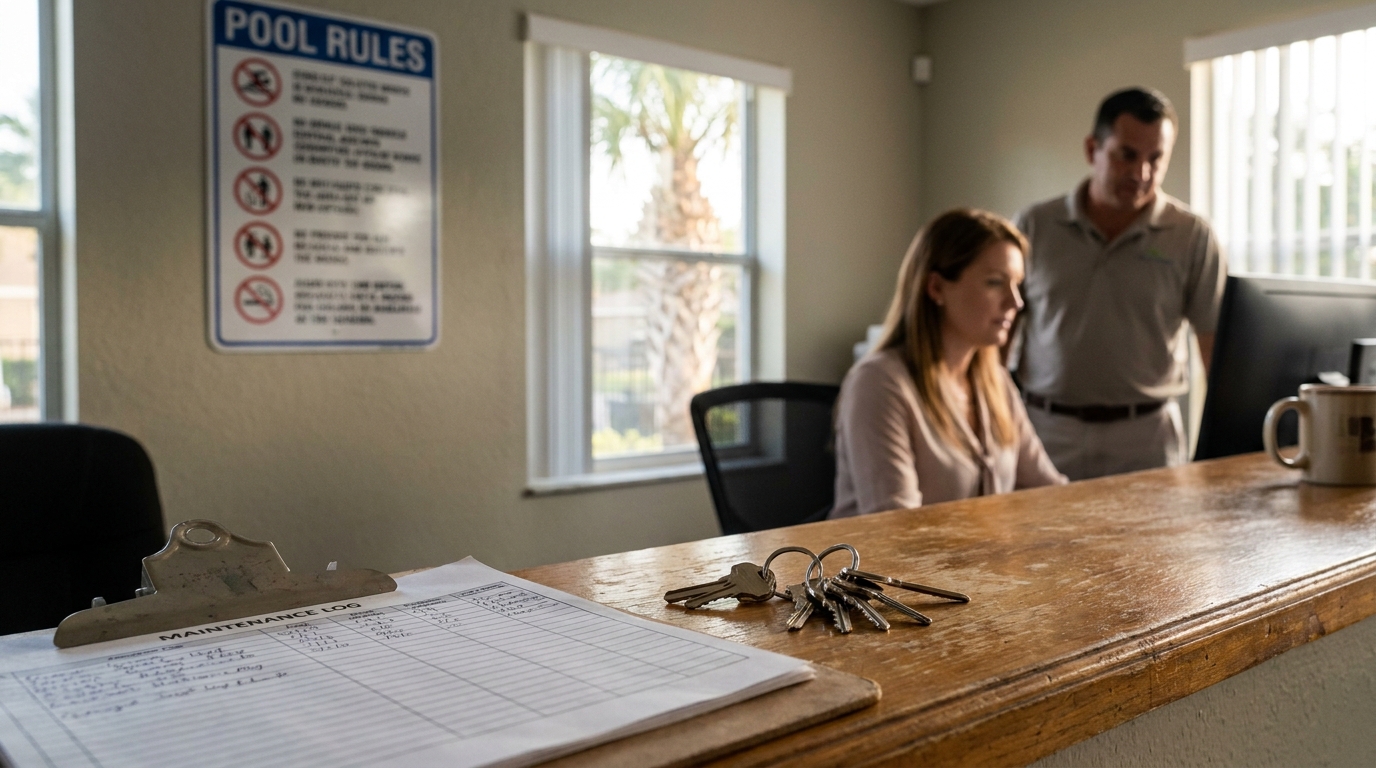
- Maintenance logs, inspection schedules, and prior repair requests
- Witness statements from other residents or guests
- Medical records connecting your injuries to the fall
💡 Pro Tip: Ask the association in writing to preserve any surveillance footage of the pool area. Many systems overwrite recordings within days.
Common Hazards and Who May Be Responsible
Pool deck dangers usually fall into recurring categories, each supporting a negligence theory. The association’s statutory powers in § 718.111 include various authorities (including the language about "mechanical, electrical, and plumbing elements serving an improvement or a building" in § 718.111(3)(b) referenced in certain contexts), but the duty to maintain common elements such as drainage systems is expressly established by Fla. Stat. § 718.113(1).
Maintenance-Related Hazards
Many falls trace back to deferred upkeep. Cracked pavers, uneven surfaces, broken tiles, missing slip-resistant coatings, and clogged drains that allow standing water are frequent culprits. Because Fla. Stat. § 718.113(1) directs the association to provide for "maintenance, repair, and replacement," a failure to address these conditions can support a condominium negligence pool deck claim.
When Responsibility May Shift
Not every area is the association’s sole responsibility. Fla. Stat. § 718.113(1) notes that "The declaration may provide that certain limited common elements shall be maintained by those entitled to use the limited common elements." A private patio adjoining a unit may be treated differently than the main pool deck.
| Area | Typical Responsibility | Why It Matters |
|---|---|---|
| Main pool deck | Association (common element) | Strong basis for association liability |
| Shared walkways | Association (common element) | Maintenance duty under § 718.113(1) |
| Drainage/plumbing | Association (§ 718.111; § 718.113(1)) | Standing water claims |
| Limited common element | May shift to unit owner per declaration | Liability can be disputed |
💡 Pro Tip: If signage warned of a wet surface but the hazard was unreasonable or long-standing, a warning sign alone does not eliminate the association’s responsibility.
Comparative Fault and Deadlines That Affect Your Claim
Florida uses a modified comparative fault system that can reduce or bar recovery. Under Fla. Stat. § 768.81(6), "any party found to be greater than 50 percent at fault for his or her own harm may not recover any damages." If you are 50 percent or less at fault, your recovery is reduced proportionally.
Timing is critical because Florida sets a firm window for negligence lawsuits. Under Florida’s negligence framework, Fla. Stat. § 95.11(4)(a) requires that "An action founded on negligence" be filed "within two years." This two-year period applies to causes of action accruing on or after March 24, 2023. Missing this deadline usually bars the claim permanently. While limited exceptions exist, courts interpret them narrowly.
One procedural point often surprises condo residents. Florida’s condominium dispute statute, Fla. Stat. § 718.1255(1), provides that a "dispute" does not include "claims for damages to a unit based upon the alleged failure of the association to maintain the common elements." This means maintenance-based injury claims can often proceed in court without mandatory pre-suit arbitration.
Steps to Protect Your Pool Deck Injury Claim
Acting promptly makes the strongest difference in a Florida pool slip and fall claim. What you do after a fall shapes the evidence available later. Consider these steps:
- Report the fall to the association and request a written incident report
- Seek medical care quickly so injuries are documented and treated
- Photograph the hazard, your injuries, and surrounding conditions
- Save your footwear and clothing as they were at the time of the fall
- Avoid giving recorded statements to insurers before understanding your rights
Insurance dynamics influence how these claims unfold. Associations are required under Fla. Stat. § 718.111(11) to "obtain adequate insurance for the condominium property." Rising premiums and stricter rules following recent reforms have changed the landscape, affecting how aggressively insurers handle claims.
Because outcomes depend on specific facts, guidance from a qualified attorney is valuable. Working with a Florida premises liability attorney familiar with condominium claims can help you understand what your situation may be worth and how to pursue it.
💡 Pro Tip: Keep a journal of your symptoms, missed work, and out-of-pocket costs to support claims for medical expenses, lost wages, and pain and suffering.
Frequently Asked Questions
1. Can the association avoid liability by posting a "wet floor" sign?
Not necessarily. A warning sign is one factor a court may weigh, but it does not erase the association’s duty to maintain a reasonably safe pool area under Fla. Stat. § 718.113(1). If the hazard was unreasonable or long-standing, liability may still exist.
2. What if I was partly at fault for my fall?
You may still recover reduced damages. Under Fla. Stat. § 768.81(6), being 50 percent or less at fault reduces your recovery proportionally, while being more than 50 percent at fault bars recovery entirely.
3. How long do I have to file a pool deck fall lawsuit?
Generally two years from the date of injury. Fla. Stat. § 95.11(4)(a) sets a two-year limit for negligence actions accruing on or after March 24, 2023. Exceptions are interpreted narrowly.
4. Do I have to go through arbitration before suing the association?
Often, no, for maintenance-based injury claims. Fla. Stat. § 718.1255(1) excludes claims tied to the association’s failure to maintain common elements from mandatory pre-suit dispute procedures.
5. What kinds of damages might be available?
Recovery can include medical expenses, lost wages, and pain and suffering. The amount depends on injury severity, evidence strength, and any comparative fault assigned.
Holding the Association Accountable
A Florida condo association can be liable for a pool deck fall when it breaches its statutory duty to maintain common areas and that failure causes injury. Florida law gives injured residents and guests a clear framework: the association controls the pool deck, must keep it reasonably safe, and may be held responsible when it ignores known or foreseeable hazards. Proving actual or constructive knowledge under Fla. Stat. § 768.0755, preserving evidence, and respecting the two-year deadline in Fla. Stat. § 95.11(4)(a) are central to building a strong case.
You do not have to navigate a condo association and its insurer alone. Reach out to Attorney Big Al at 1-800-HURT-123 by calling 1-800-487-8123 or visiting our free consultation request page today. Protect your rights, preserve your evidence, and let a trusted team help you pursue the compensation you may deserve.
