

Understanding Florida’s Slip and Fall Filing Clock
Key Takeaways: In most Florida slip and fall cases, the statute of limitations begins on the date you fell and were hurt, when the negligent act and resulting harm come together under Fla. Stat. § 95.031. Following 2023 HB 837 tort reform, negligence claims must be filed within two years of accrual under Fla. Stat. § 95.11(4)(a), replacing the prior four-year period for claims accruing on or after the effective date. To win, you must show the business had actual or constructive knowledge of the hazard under Fla. Stat. § 768.0755. Tolling can pause the clock only in narrow situations, such as defendant concealment or plaintiff minority, though minors face a 7-year outer limit. Florida’s modified comparative fault rule bars recovery if you are more than 50 percent at fault. Preserving evidence early and confirming your deadline promptly are critical steps.
In most Florida slip and fall cases, the statute of limitations begins on the date you fell and were hurt. The fall itself starts the countdown, and the law treats that moment as when a valid negligence claim exists. Waiting too long permanently closes the courthouse doors. Whether you slipped on a grocery store spill or wet restaurant floor in Hollywood, knowing when the clock starts protects your right to recover.
If you or a loved one was injured, do not leave your deadline to chance. Reach out to Attorney Big Al at 1-800-HURT-123 for guidance, call 1-800-487-8123 to discuss your situation, or use our secure online contact form to get answers about your rights.
When the Clock Starts: Date of Injury Accrual in Florida
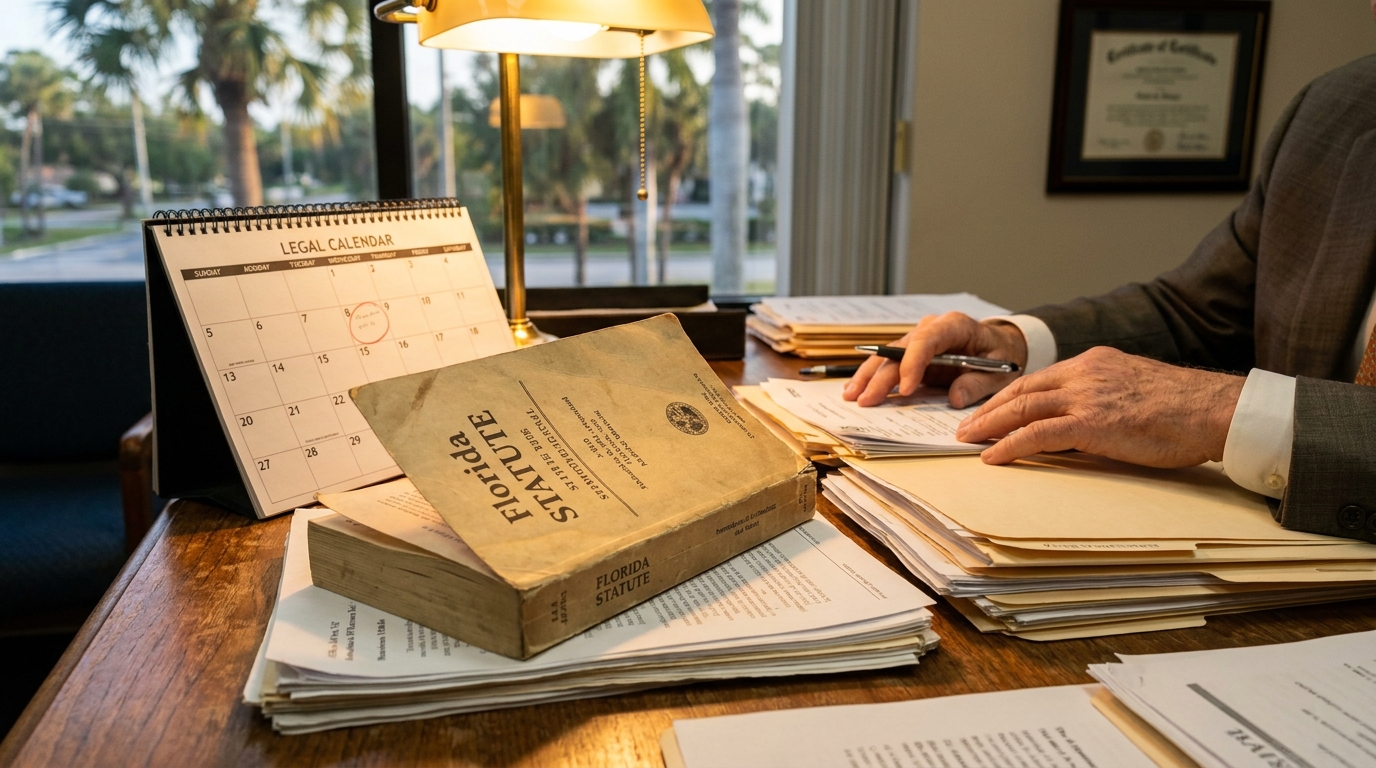
The countdown for a Florida slip and fall lawsuit typically starts on the date the fall occurred and the injury was sustained. This is the "accrual" of your cause of action. Florida’s general accrual doctrine holds that a claim accrues when the last element constituting the cause of action occurs, when the negligent act and resulting harm come together, so the injury date usually anchors the timeline.
Accrual timing is governed by Fla. Stat. § 95.031, which operates alongside the limitation lengths listed in Fla. Stat. § 95.11. The practical result for most premises cases is that the two-year clock generally starts when the injury occurs.
💡 Pro Tip: Write down the exact date, time, and location of your fall as soon as you can. That single detail often determines your filing deadline and can be difficult to reconstruct months later.
The Florida Slip and Fall Statute of Limitations Explained
Under current Florida law, a slip and fall claim must generally be filed within two years of the date the cause of action accrues. This is set out in Fla. Stat. § 95.11(4)(a), which places negligence actions under the "Within Two Years" subsection. You can review these deadlines directly in Florida’s limitations statutes maintained by the state legislature.
The florida slip and fall statute of limitations is unforgiving once it expires. If you file even one day late, the business can move to dismiss your case, and courts routinely enforce these deadlines. For a deeper look at how this rule works in practice, our overview of the Florida premises liability deadline walks through the two-year period step by step.
How HB 837 Changed the Deadline
The two-year window reflects a significant 2023 tort reform package known as HB 837, enacted as chapter 2023-15. Before this change, many negligence claims carried a four-year limit. HB 837 moved negligence into the new two-year subsection of Fla. Stat. § 95.11(4). This two-year period applies to causes of action accruing on or after March 24, 2023; claims that accrued before that date generally remain governed by the prior four-year period.
Certain actions founded on the design, planning, or construction of an improvement to real property still carry a four-year limit under Fla. Stat. § 95.11(3)(b). A construction-defect claim is different from an ordinary premises slip-and-fall, and the applicable deadline may vary with the theory of the case.
Proving Negligence Under Florida Premises Liability Law
Florida law places a significant burden on the injured plaintiff to prove the business knew or should have known about the hazard. Under Fla. Stat. § 768.0755(1), a person who slips and falls on a transitory foreign substance in a business establishment must prove that the business had actual or constructive knowledge of the dangerous condition and should have taken action to remedy it. You can read the full text of Florida’s slip and fall statute for the exact language.
Because proving what the business knew is often the hardest part of these cases, evidence preservation is essential. Photographs, incident reports, surveillance footage, and prompt medical records can make the difference between a strong claim and a dismissed one. An experienced slip and fall attorney Florida residents rely on can help gather and protect this proof.
Actual vs. Constructive Knowledge
Constructive knowledge can be shown through circumstantial evidence in two main ways. Under Fla. Stat. § 768.0755(1)(a)-(b), you may demonstrate that the dangerous condition existed long enough that, in the exercise of ordinary care, the business should have known about it, or that the condition occurred with regularity and was therefore foreseeable.
Here are common categories of evidence that can support the knowledge element:
- Surveillance video showing how long a spill remained on the floor
- Employee statements or cleaning logs indicating inspection schedules
- Photos of the hazard taken immediately after the fall
- Witness accounts describing recurring conditions at the location
- Maintenance records suggesting the problem happened with regularity
💡 Pro Tip: Request that the business preserve its surveillance footage in writing as soon as possible. Many systems overwrite recordings within days, and once that video is gone, it can be difficult to prove how long a hazard existed.
When the Deadline May Be Paused: Tolling Rules
Florida law strictly limits the circumstances under which the statute of limitations can be paused, or tolled. Under Fla. Stat. § 95.051(1) and (2), permissible tolling grounds include the defendant’s absence from the state, use of a false name to evade service, concealment to avoid service, adjudicated incapacity of the plaintiff before accrual, and the minority of the plaintiff in certain situations. The statute makes clear that a disability or other reason does not toll the running of any limitations period except those specifically listed. Courts interpret these exceptions narrowly.
If your fall occurred on public or government property, separate notice requirements and shorter timelines may apply. Because these situations are fact-dependent, the safest approach is to confirm the applicable deadline early.
Special Rules for Minors
For a minor injured in a slip and fall, the limitations period may be tolled under certain conditions. Fla. Stat. § 95.051(1)(i) allows tolling during any period in which no parent, guardian, or guardian ad litem exists, or when such a person has an interest adverse to the minor. However, the statute provides that the action must be begun within 7 years after the occurrence. This outer limit means families should not delay.
| Situation | General Deadline |
|---|---|
| Adult slip and fall (negligence) | 2 years from date of injury (Fla. Stat. § 95.11(4)(a)) |
| Minor with no qualifying guardian | Tolled, but no later than 7 years from the incident (§ 95.051(1)(i)) |
| Construction/design defect claim | 4 years (Fla. Stat. § 95.11(3)(b)) |
Protecting Your Claim Before Time Runs Out
Acting quickly preserves both your deadline and the value of your recovery. As part of HB 837, Florida adopted a modified comparative fault standard under Fla. Stat. § 768.81(6), which bars any plaintiff found to be greater than 50 percent at fault from recovering damages. Because a business may try to shift blame onto you, gathering evidence early can help minimize the fault assigned to you and keep your claim viable.
💡 Pro Tip: Seek medical attention right away and keep every record. Gaps in treatment can be used to argue your injuries were minor, which may reduce compensation regardless of how strong your liability case is.
Frequently Asked Questions
-
When does the clock start for a Florida slip and fall claim?
In most cases, the clock starts on the date of injury accrual, which is generally the day the fall occurred and the injury was sustained, when the negligent act and resulting harm come together.
-
How long do I have to file a slip and fall lawsuit in Florida?
Under Fla. Stat. § 95.11(4)(a), a negligence action must be filed within two years of accrual. This HB 837 two year rule applies to claims accruing on or after March 24, 2023; claims that accrued earlier were generally subject to the prior four-year period.
-
Can the deadline ever be extended?
In limited circumstances, yes. Tolling may apply under Fla. Stat. § 95.051 for reasons such as the defendant concealing themselves or a plaintiff’s minority, but courts interpret these narrowly and they do not apply automatically.
-
What do I have to prove to win a slip and fall case?
Under Fla. Stat. § 768.0755, you must show the business had actual or constructive knowledge of the dangerous condition and failed to remedy it. Constructive knowledge can be shown through evidence of how long the hazard existed or that it recurred regularly.
-
What happens if I was partly at fault for my fall?
Florida follows modified comparative fault under Fla. Stat. § 768.81(6). If you are found more than 50 percent at fault, you are barred from recovering any damages, so minimizing assigned fault is important.
Do Not Let the Deadline Decide Your Case
The florida slip and fall statute of limitations gives most victims only two years, and that window can pass faster than you expect. From proving the business knew about the hazard to preserving surveillance footage and medical records, the strongest claims are built early. Because tolling exceptions are applied narrowly, confirming your deadline promptly is one of the most important steps you can take.
If you were hurt in a fall, do not wait until your time runs out. Contact Attorney Big Al at 1-800-HURT-123 for a case review, call 1-800-487-8123 to speak with our team, or reach us through our confidential consultation request so we can help you take the next step.
