

Can I sue insurance company: Denied? Master 2025
Navigating Your Rights with Florida Insurance Companies
If you’re wondering, Can I sue insurance company, you’re likely facing a frustrating situation with your insurer in Florida. Perhaps after a car accident, they’re delaying payment, offering too little, or denying your claim outright. This is a difficult position, especially during recovery.
The short answer is yes, you can sue your insurance company in Florida. Grounds for a lawsuit include:
- Acting in “bad faith” (not dealing with you fairly)
- Breaching your insurance contract
- Unreasonably delaying your claim
- Denying a valid claim without proper reason
- Offering a settlement far below your claim’s value
This guide explains your rights and the steps for taking legal action against an insurer. We’ll cover bad faith, pre-lawsuit actions, and the legal process to help you secure the compensation you deserve.
When Can I Sue an Insurance Company in Florida?
When you pay insurance premiums, you expect your provider to honor their commitment. If they fail to do so after a car accident or property damage, you may have grounds to sue. You can consider legal action in Florida if your insurer commits a breach of contract by not following your policy terms, acts in “bad faith” by dealing with you unfairly, unreasonably delays or underpays your claim, misrepresents policy terms, or fails to defend you in a third-party lawsuit. Knowing you can sue insurance company is the first step toward getting the benefits you are owed.

Common Grounds for a Lawsuit in Fort Lauderdale
Your insurance policy is a legal contract. A common reason for a lawsuit is a “breach of contract,” where the insurer fails to meet its obligations. For example, if your policy covers a specific type of damage and your claim is denied, that’s a breach. This happens with many policy types. With auto insurance, we see denied Personal Injury Protection (PIP) benefits, uninsured/underinsured motorist disputes, and property damage disagreements. Homeowners insurance claims for hurricane or fire damage often lead to disputes over coverage or payment delays. Beneficiaries of disability or life insurance policies can also sue if benefits are wrongfully denied.
For more info about specific types of personal injury claims, you can visit our page on what are the different types of personal injury claims.
Understanding and Proving Insurance ‘Bad Faith’ in Boca Raton
“Bad faith” is a serious violation where an insurer fails its “duty of good faith and fair dealing.” This is more than a mistake; it’s unreasonable or deceptive conduct. Examples of bad faith include:
- Failing to investigate your claim properly.
- Unreasonably denying a valid claim.
- Offering a lowball settlement that is far less than your claim’s worth.
- Unreasonably delaying claim processing or payment.
- Misrepresenting what your policy covers.
- Failing to communicate with you in a timely manner.
Proving bad faith requires showing the insurer acted intentionally or with reckless disregard for your rights. Documenting misconduct is critical. Keep detailed records of all communications, including dates, names, and discussion points. This evidence is vital for legal action.
For more information on how a car accident lawyer in Hollywood can help you deal with aggressive insurance adjusters, visit our page on how a car accident lawyer in Hollywood can help you deal with aggressive insurance adjusters.
What to Do Before Filing a Lawsuit Against Your Insurer
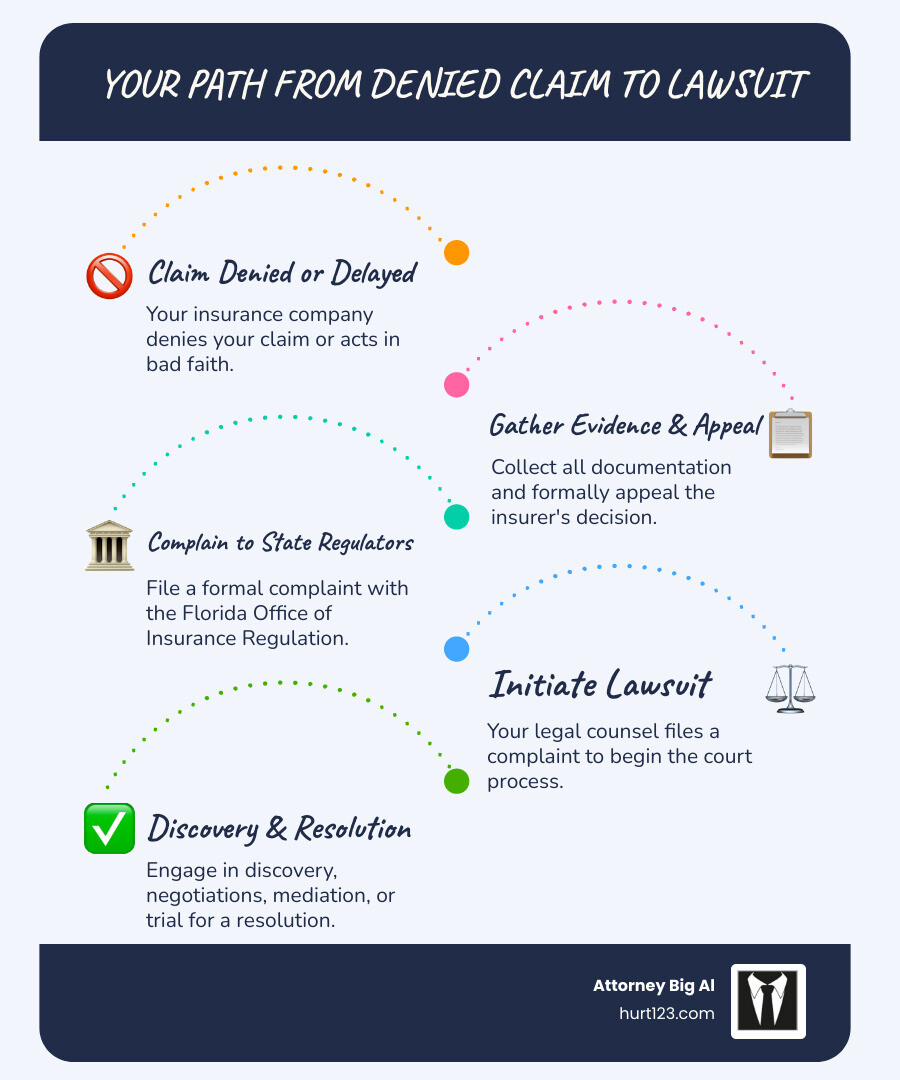
Before heading to court, it’s wise to take several preliminary steps. Filing a lawsuit should be a last resort, and these actions can sometimes resolve the issue without the need for litigation. If not, they will strengthen your case significantly.

Step 1: Gather All Your Documentation
Organization is key. Collect every document related to your claim to build a strong foundation for your case. This includes:
- Your insurance policy: Read it to understand your coverage, exclusions, and terms.
- Claim forms and denial letter: Keep copies of everything you submitted and the insurer’s written reason for denial.
- Communication records: Log all emails, letters, and phone calls. Note the date, time, representative’s name, and a summary of the discussion.
- Supporting evidence: Gather photos and videos of damage, receipts for expenses, medical records, and police reports.
Step 2: Formally Appeal the Insurer’s Decision
Most insurers have an internal appeal process. Use this to formally challenge their decision. Submit a written appeal explaining why you believe the denial was wrong, referencing your policy and the evidence you’ve gathered. Be professional but firm. If you have new evidence, such as additional receipts or a second medical opinion, include it. Follow the company’s procedures and deadlines carefully to avoid a denial on a technicality. If the appeal is denied, request a final decision in writing. For more detailed guidance on dealing with denied claims, check out our page on denied claim personal injury lawyer in Hollywood, Florida.
Step 3: File a Complaint with the State Regulator
If the internal appeal fails, contact the Florida Office of Insurance Regulation. While they cannot force the insurer to pay your claim, they can investigate for violations of state law, facilitate communication, and create an official record of your insurer’s conduct. This non-binding step can sometimes motivate an insurer to become more reasonable. Your complaint also contributes to the record of an insurer’s behavior, which is valuable if there’s a pattern of poor treatment. For general information about filing a complaint with your state department of insurance, there are helpful resources available to guide you through the process.
The Legal Process: What to Expect When Suing an Insurer in Miami
If pre-suit steps fail, a lawsuit may be necessary. This is a complex process that can take months or years to resolve, so it’s important to know what to expect.
How the Lawsuit Begins
- Filing a Complaint: Your car accident lawyer drafts and files a formal complaint with the court, outlining your case and requested damages.
- Serving the Insurer: The lawsuit documents are formally delivered to the insurance company, a process known as “service of process.”
- Insurer’s Response: The insurer has a set time to respond, either with an “answer” to your complaint or a “motion to dismiss” the case.
For more information about settling versus going to trial, check out our page on settling vs. trial injury lawyers in Boca Raton.
The Findy and Negotiation Phase
This is often the longest phase, where both sides gather information.
- Findy: Both sides exchange documents and evidence. This includes interrogatories (written questions answered under oath) and depositions (sworn, out-of-court testimony from witnesses).
- Mediation and Settlement: Most cases settle before trial. Mediation involves a neutral third party who helps both sides negotiate. Settlement talks often continue throughout the process as the insurer may want to avoid the risk and cost of a trial.
For more information about settlement negotiations, visit our page on settlement negotiations in Pembroke Pines.
Florida’s Rules: Deadlines and Specifics You Can’t Ignore
Florida has strict deadlines for insurance-related lawsuits. Missing a deadline under the statute of limitations can permanently bar you from recovering compensation.

What You Need to Know Before You Sue an Insurance Company
The deadline to file a lawsuit varies by case type:
- Breach of Contract: You generally have five years.
- Bad Faith Claims: You have four years from when the bad faith action occurred.
- Personal Injury: The deadline is only two years from the date of the accident.
Florida’s “no-fault” car insurance laws add complexity. Your Personal Injury Protection (PIP) should cover up to $10,000 in medical bills and lost wages. However, insurers often deny claims based on two key rules:
- 14-Day Treatment Rule: You must seek medical care within 14 days of the accident to be eligible for PIP benefits.
- Emergency Medical Condition (EMC): To receive the full $10,000, a doctor must diagnose you with an EMC. Otherwise, benefits may be capped at $2,500.
Disputes over Uninsured/Underinsured Motorist (UM/UIM) coverage are also common. If your insurer wrongfully denies your UM/UIM claim, you have grounds for a lawsuit. For more information about understanding uninsured and underinsured motorist coverage in Florida, we’ve got you covered.
How Different Insurance Types Affect Your Case in Sunrise
The type of insurance policy shapes your case and the evidence required.
- Car Accident Claims: Focus on medical records, police reports, and proof of injury. Insurers often dispute the necessity of treatment or blame pre-existing conditions.
- Homeowners Insurance: Require property damage assessments, contractor estimates, and photos/videos. Disputes often arise over the extent of damage or what is covered.
- Disability Claims: Hinge on extensive medical documentation proving your inability to work. Insurers may use their own doctors to dispute your claim.
- Life Insurance Disputes: Often involve questions about beneficiaries, policy validity, or cause of death.
Here’s a quick comparison of what matters most in different types of claims:
| Feature | Auto Policy Claims | Homeowner Policy Claims |
|---|---|---|
| Primary Evidence | Medical records, police reports, vehicle repair estimates | Property damage reports, contractor estimates, photos |
| Focus of Dispute | Injury severity, causation, lost wages, vehicle value | Extent of damage, covered perils, repair costs, living expenses |
| Key Experts | Doctors, accident reconstructionists, vocational professionals | Appraisers, engineers, contractors, adjusters |
| Common Denials | PIP limits, pre-existing conditions, disputed fault | Exclusions (flood, mold), insufficient damage claims |
What Compensation Can You Recover in an Insurance Lawsuit?
If you successfully sue your insurance company, you can recover compensation for your losses. The types of damages depend on your case and the insurer’s conduct.

Types of Damages You Can Claim
Compensatory damages are meant to cover your actual losses. This can include:
- The full value of your original claim: The money the insurer should have paid initially.
- Medical bills: Out-of-pocket costs incurred due to claim delays.
- Lost wages: Income lost because the insurer failed to pay your claim promptly.
- Property damage: Additional repair costs or other expenses caused by delays.
- Emotional distress: Compensation for significant anxiety or depression caused by the insurer’s bad faith actions.
- Consequential damages: Other financial losses, like late fees on a mortgage, resulting from the insurer’s wrongful conduct.
- Attorney’s fees and court costs: In many bad faith cases, Florida law allows you to recover these expenses.
For more info about how a Miami car accident lawyer calculates damages, visit our page on how a Miami car accident lawyer calculates damages.
Punitive Damages for Egregious Conduct
Punitive damages are not for compensating losses but for punishing the insurer for outrageous behavior and deterring future misconduct. Obtaining them requires a high standard of proof, showing the insurer acted with intentional misconduct or reckless disregard for your rights. Florida law also places caps on punitive damages, typically limiting them to three times the compensatory damages or $500,000, whichever is greater. These are reserved for the most egregious cases.
Frequently Asked Questions about Suing an Insurance Company
How long does it take to sue an insurance company?
The timeline varies. A straightforward case might settle in a few months, while complex cases can take several years, depending on the insurer’s cooperation and court schedules. Most cases settle before trial.
How much does it cost to sue an insurance company?
We work on a contingency fee basis, meaning you pay no upfront fees. Our fee is a percentage of the compensation we recover for you. You only pay if we win. We typically advance case costs, like filing fees, which are reimbursed from the settlement or award.
Can I sue my own insurance company for a car accident?
Yes, you can sue your own insurance company. This is common in Florida for several reasons:
- Denial of PIP benefits: Your insurer might wrongfully deny your Personal Injury Protection claim based on the 14-day rule or lack of an Emergency Medical Condition (EMC) diagnosis.
- Denial of UM/UIM claims: If you’re hit by an uninsured or underinsured driver, your own insurer should cover your damages under your UM/UIM policy. A wrongful denial is grounds to sue.
- Bad faith: Unreasonable delays, improper investigations, or lowball settlement offers from your own insurer constitute bad faith.
For more information about dealing with uninsured drivers and how we can help, visit our page on dealing with uninsured drivers: how a car accident lawyer in Hollywood can help.
How a Lawyer Helps When You Sue an Insurance Company
Facing an insurance company alone is daunting. They have extensive resources and legal teams dedicated to minimizing payouts. A car accident lawyer provides crucial support, offering legal guidance, assisting with evidence gathering, and providing negotiation leverage. We can provide strong court representation to protect your rights and secure the compensation you are owed. We are Attorney Big Al, and we are here to help.

Why You Shouldn’t Handle a Claim Alone
Handling a complex insurance lawsuit alone is risky. A lawyer makes a critical difference by:
- Navigating Complex Procedures: We understand the intricate court rules and deadlines, ensuring your case is handled correctly.
- Countering Insurer Tactics: Insurance companies use strategies to delay, underpay, or deny claims. We know these tactics and how to fight them, leveling the playing field.
- Maximizing Your Compensation: We calculate all potential damages to ensure you pursue the full amount you deserve.
- Providing Peace of Mind: With us handling the legal burdens, you can focus on your recovery.
For more information on why you shouldn’t handle a car accident claim without a car accident lawyer in Sunrise, visit our page on why you shouldn’t handle a car accident claim without a car accident lawyer in Sunrise. If you’re facing a dispute with your insurer in Fort Lauderdale and wondering Can I sue insurance company, a dedicated car accident lawyer can fight for the benefits you truly deserve.
