
Understanding Rear Underride Guards on Florida’s Highways
Key Takeaways: FMVSS 224 is the federal safety standard requiring many trailers and semitrailers to carry rear underride guards, steel bars designed to stop passenger cars from sliding beneath a trailer in a rear-impact crash, while FMVSS 223 sets the strength and testing rules for the guard hardware. These protections matter because underride collisions can allow a trailer to intrude into the passenger compartment, producing catastrophic head, neck, and spinal injuries. Florida reinforces the federal rules through statutes like FL Sec. 316.515(3)(b), meaning a missing, corroded, or non-compliant guard can support negligence, negligence-per-se, or products liability theories. Responsibility may extend to the truck driver, trucking company, or manufacturer, with fault apportioned under Florida’s modified comparative negligence system, which bars recovery for anyone more than 50 percent at fault. Most negligence and wrongful death claims must be filed within two years, and physical evidence like the guard can disappear quickly, making early preservation critical to a strong claim.
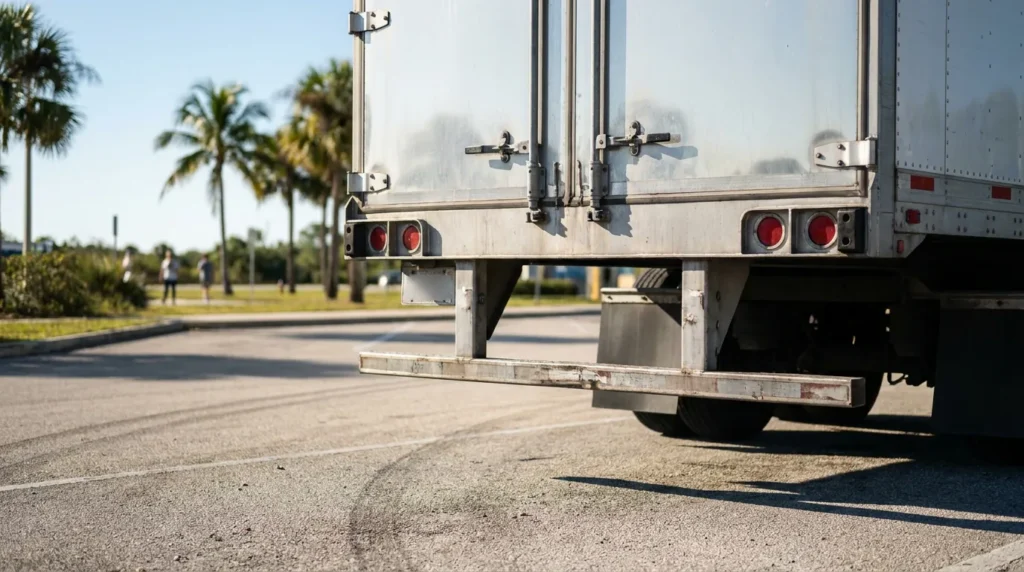
A rear underride guard is the steel bar hanging from the back of a semitrailer that stops a passenger car from sliding underneath during a rear-impact crash. FMVSS 224 requires many trailers and semitrailers to be equipped with these rear impact guards, while FMVSS 223 sets the strength and testing rules for the guard hardware. For Florida families dealing with a devastating truck crash injury, understanding how this safety equipment works can make the difference between full recovery of damages and a claim that leaves money on the table.
If you or a loved one was hurt in a collision involving a commercial truck, help is available right now. You can reach Attorney Big Al at 1-800-HURT-123 by phone at 1-800-487-8123 or through the firm’s online case review page to discuss your options with no obligation.
What FMVSS 224 Requires and Why It Matters
FMVSS 224 exists because a car striking the rear of a high-riding trailer can slide beneath it, allowing the trailer to intrude into the passenger compartment where seat belts and airbags cannot protect occupants. These underride collisions are among the most catastrophic events on the road, frequently producing head, neck, and spinal injuries that would not occur in an ordinary rear-end crash. The standard requires qualifying trailers to carry a rear guard positioned low enough and strong enough to engage a car’s bumper structure.
Florida law reinforces this federal requirement. Under FL Sec. 316.515(3)(b), a semitrailer more than 48 feet but not more than 57 feet may operate on public roads only if equipped with a substantial rear-end underride protection device meeting the requirements of 49 C.F.R. s. 393.86, Rear End Protection. You can review this provision within the state’s traffic code chapter through the official Florida motor vehicle statutes published by the Legislature.
Because Florida cross-references the federal rules, a missing or damaged guard carries legal weight in a civil case. The federal regulation at 49 C.F.R. 393.86 is paired with FMVSS 223 and 224, so a non-compliant device may support a negligence or negligence-per-se theory. This is why documenting the exact condition of the guard after a crash is critical for anyone pursuing an underride crash claim.
How FMVSS 224 Underride Guard Rules Protect Florida Truck Crash Victims
The fmvss 224 underride guard framework protects victims in two ways: it aims to prevent the underride from happening, and it creates a documented safety duty that supports accountability when a guard fails. When a trailer that should have a compliant rear impact guard lacks one, or the guard is corroded, bent, or improperly installed, that failure can become central evidence in a Florida truck accident case.
Florida law recognizes that a defective safety device can make injuries worse than they otherwise would have been. FL Sec. 768.81(1)(d) covers an action alleging that injuries received by a claimant in an accident were greater than the injuries the claimant would have received but for a defective product. This "enhanced injuries" concept supports the argument that a faulty underride guard in Florida increased the severity of harm even where another party caused the initial impact.
Several categories of evidence typically matter in these cases:
- Maintenance and inspection records showing whether the rear impact guard was serviced or replaced
- Photographs and measurements of the guard’s height, condition, and mounting points
- The truck’s electronic control module data and the driver’s logs
- Manufacturer specifications confirming whether the device met FMVSS 223 and 224
💡 Pro Tip: Ask that the trailer and its rear guard be preserved before the trucking company repairs or scraps the equipment. A prompt preservation request can prevent the loss of the single most important piece of physical evidence in an underride case.
Who Can Be Held Responsible After an Underride Crash
Responsibility in an underride collision may extend well beyond the driver behind the wheel. Depending on the facts, fault could rest with the truck driver, the trucking company that maintained the trailer, or a manufacturer that built or installed a defective rear impact guard. Florida law allows fault to be apportioned among multiple parties and even nonparties.
Florida’s apportionment rules are grounded in comparative fault rather than joint and several liability. Under Fla. Stat. §768.81(3), a court enters judgment against each liable party based on that party’s percentage of fault. In practice, a negligent tortfeasor’s degree of liability is generally limited to their own degree of fault, and a defendant may plead and prove that a codefendant or nonparty should be apportioned some or all of the fault.
This framework expressly reaches products liability claims. FL Sec. 768.81(1)(d) defines a products liability action as one based on strict liability, negligence, breach of warranty, nuisance, or similar theories for damages caused by the manufacture, construction, design, formulation, installation, preparation, or assembly of a product. A non-compliant underride guard in Florida can be pursued against a manufacturer alongside driver or carrier negligence. For a broader look at potential defendants, our guide on who can be held liable after a Florida truck crash walks through the common possibilities.
How Comparative Fault Affects Your Recovery
Comparative negligence determines how much a victim can actually recover once fault is divided. Since a 2023 amendment, Florida applies a modified comparative negligence standard: under Fla. Stat. §768.81(6), any party found to be greater than 50 percent at fault for their own harm may not recover any damages.
Understanding the difference between fault systems helps set realistic expectations. Some states follow a pure comparative negligence rule, under which a plaintiff may claim damages for the percentage they are not at fault even if 99 percent at fault, while Florida now follows the modified approach.
| Fault System | General Effect on Recovery |
|---|---|
| Pure comparative negligence | Plaintiff may recover their non-fault share even if mostly at fault |
| Florida modified (post-2023) | No recovery if the plaintiff is more than 50% at fault |
Florida commentators argue that apportionment should turn on causation rather than the technical existence of a duty. As one analysis of the state’s fault rules explains, causation-based apportionment is the only principled way to ensure that defendants are held liable for only the portion of plaintiffs’ damages that is attributable to the defendants’ conduct. This causation focus is exactly why proving that a failed rear guard contributed to your injuries can be so valuable, a point examined further in this Florida Bar Journal analysis.
Deadlines That Can Make or Break a Claim
Timing is one of the most unforgiving parts of any Florida truck accident case. A Florida truck crash victim generally has two years from the date of the crash to file a negligence lawsuit, because FL Sec. 95.11(5) requires actions founded on negligence to be brought within two years for causes of action accruing on or after March 24, 2023. If an underride collision is fatal, a separate two-year wrongful death deadline applies under FL Sec. 95.11(5)(e).
Exceptions to these deadlines exist, but courts interpret them narrowly. Tolling or delayed-discovery arguments may apply in limited circumstances and do not apply automatically. Because these civil litigation deadlines are separate from any administrative or crash-reporting obligations, speak with a Florida truck accident attorney well before the two-year mark rather than assuming an extension will be available.
Frequently Asked Questions
1. What is the difference between FMVSS 223 and FMVSS 224?
FMVSS 224 requires that qualifying trailers and semitrailers be equipped with a rear impact guard, while FMVSS 223 sets the performance, strength, and testing standards for the guard hardware. Together they form the federal underride protection scheme, and Florida reinforces the related federal rule at 49 C.F.R. s. 393.86 through FL Sec. 316.515(3)(b).
2. Can I still recover if I was partly at fault for the crash?
In many cases, yes, provided you were not more than 50 percent at fault. Under Fla. Stat. §768.81(6), a party found greater than 50 percent at fault for their own harm may not recover damages.
3. How long do I have to file an underride crash claim in Florida?
Generally two years from the date of the crash for a negligence claim under FL Sec. 95.11(5), for causes of action accruing on or after March 24, 2023. A fatal underride collision is governed by the same two-year period for wrongful death actions.
4. Can a trailer manufacturer be sued for a defective underride guard?
Under certain circumstances, yes. FL Sec. 768.81(1)(d) treats claims for harm caused by a product’s design, manufacture, or installation as products liability actions, which means a defective rear guard may support a claim against a manufacturer alongside driver or carrier fault.
5. What should I do right after an underride crash?
Prioritize medical care, then focus on preserving evidence. Photograph the vehicles and the trailer’s rear guard if safe to do so, keep all records, and consult counsel promptly so the trailer can be preserved before it is repaired or destroyed.
Protecting Your Rights After a Florida Underride Collision
FMVSS 224 explained in plain terms is a federal safety promise that Florida law reinforces, and when that promise is broken, injured victims may have several avenues for accountability. From negligence and negligence-per-se theories tied to a non-compliant rear guard to products liability claims against a manufacturer, Florida’s comparative fault system allows responsibility to be divided among everyone whose conduct contributed to the harm. Because deadlines are short and physical evidence disappears quickly, acting early gives your semi truck accident claim the strongest possible foundation. If you want focused guidance from a trusted Florida truck accident attorney, knowledgeable help is available.
Do not wait until the two-year window is closing to protect what matters most. Reach Attorney Big Al at 1-800-HURT-123 today by calling 1-800-487-8123 or by requesting a free consultation through the firm’s contact page, and take the first step toward holding the responsible parties accountable.
