
When Dodging a Phantom Driver Leaves You Injured
Key Takeaways: In Florida, uninsured motorist (UM) coverage can pay for a swerve-to-avoid crash even without vehicle contact, because a phantom driver’s negligence can trigger your UM benefits under Fla. Stat. section 627.727, provided you supply independent corroborating evidence beyond your testimony that another vehicle caused the crash. Documentation like police reports, witness statements, dashcam footage, and prompt medical care is essential. Florida’s no-fault PIP system covers early medical costs, while UM coverage generally does not stack across vehicles unless your policy provides for it. Comparative negligence rules reduce recovery proportionate to your fault, and a party found more than 50 percent at fault cannot recover damages. UM protections extend to passengers, pedestrians, cyclists, and rideshare drivers engaged in a prearranged ride.
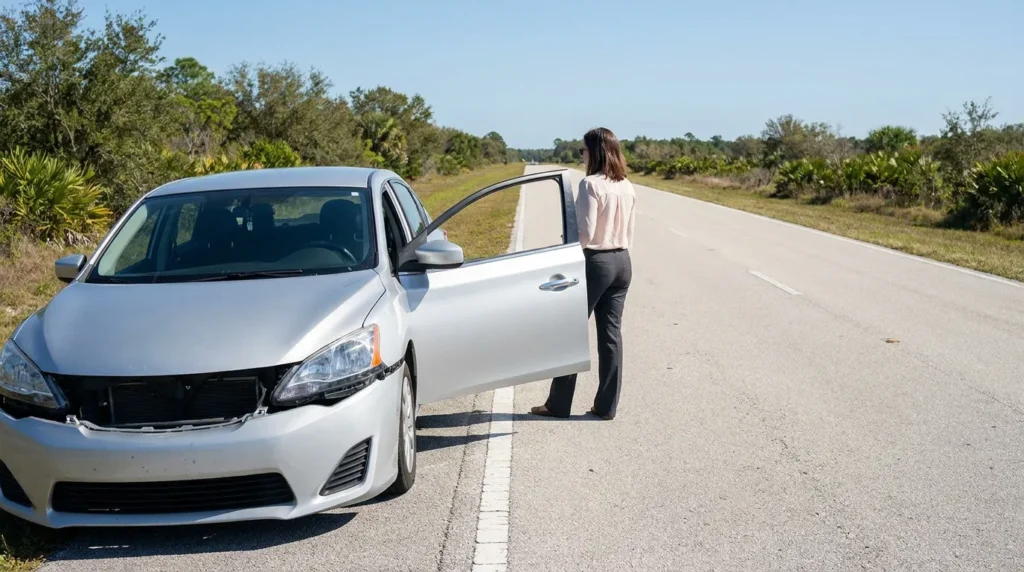
A swerve-to-avoid crash can absolutely fall within uninsured motorist coverage in Florida, even when nobody hit you. Drivers often assume that the absence of contact means there is no claim. When another vehicle forces you off the road and vanishes, your uninsured motorist coverage may step in, though Florida generally requires independent corroborating evidence that a phantom vehicle caused the crash.
If you were hurt after swerving to avoid a reckless or unidentified driver, Attorney Big Al at 1-800-HURT-123 is ready to help. Call us at 1-800-487-8123 or reach out through our online case review form.
Understanding a No Contact Car Accident in Florida
A no contact car accident happens when another driver’s negligence forces you to take evasive action that leads to a crash, without the vehicles ever touching. These are sometimes called phantom vehicle or miss-and-run collisions. The at-fault driver may run a red light, drift into your lane, or brake suddenly, forcing you to swerve, brake hard, or leave the roadway.
The driver who caused the crash is frequently unidentified or uninsured. That is where uninsured motorist coverage becomes valuable. With no other insurance policy to pursue, your own UM benefits may become the primary source of compensation.
Documentation is often the deciding factor in a phantom vehicle claim.
Florida law allows UM coverage to apply in hit-and-run situations, but only if there was actual physical contact between vehicles, or if the claim is supported by independent witness testimony or corroborating evidence.
In a true no-contact case, that independent corroboration is generally required. Witness statements, dashcam footage, skid marks, and a prompt police report can establish that a real vehicle caused your evasive maneuver.
💡 Pro Tip: Call law enforcement to the scene of any swerve to avoid crash, even without contact. A contemporaneous police report describing the phantom vehicle can be powerful evidence.
How Uninsured Motorist Coverage Fits the Picture
Uninsured and underinsured motorist coverage in Florida is governed by Fla. Stat. section 627.727 (2025). This statute sets the framework for when these benefits apply. Florida does not require drivers to carry UM coverage; insurers must offer it, but a named insured can reject it or select lower limits in writing.
When a driver is forced off the road by an uninsured motorist, they may need to turn to their own policy. If you are in a crash with an uninsured driver, you could make a claim under the uninsured motorist provisions of your own car insurance policy. That principle extends to no-contact scenarios where the responsible driver cannot be located, but Florida generally requires either physical contact or independent corroborating evidence before UM benefits apply.
The amount of UM coverage available depends on the circumstances. Under
Fla. Stat. section 627.727(8)(a)-(b) (2025), UM coverage for two or more vehicles "shall not be added together to determine the limit of insurance coverage available to an injured person for any one accident," and if the injured person is occupying a motor vehicle, "the uninsured motorist coverage available to her or him is the coverage available as to that motor vehicle."
Florida generally does not allow stacking of separate vehicles’ limits for a single accident unless your policy specifically provides for it.
Coverage May Change Based on Where You Were
Your role in the crash affects which UM limits apply. Under
Fla. Stat. section 627.727(8)(c),(e) (2025), a person occupying a non-owned vehicle "is entitled to the highest limits of uninsured motorist coverage afforded for any one vehicle as to which she or he is a named insured," and a person not occupying a motor vehicle "is entitled to select any one limit of uninsured motorist coverage for any one vehicle afforded by a policy under which she or he is insured."
These rules matter for pedestrians, cyclists, and passengers, not just drivers. If you were walking or biking when a phantom vehicle caused your injuries, you may still have UM options through a policy under which you are insured.
Rideshare Drivers Have Coverage Too
Rideshare drivers engaged in a prearranged ride are protected. Florida law requires transportation network company coverage that mirrors UM protections. Specifically,
Fla. Stat. section 627.748(7)(c) (2025) requires that while a TNC driver is engaged in a prearranged ride, required automobile insurance must include "Uninsured and underinsured vehicle coverage as required by s. 627.727."
Many rideshare crash scenarios can trigger UM benefits. You can learn more from our overview of understanding UM and UIM coverage in Florida.
Comparative Fault and Your Swerve Decision
Insurers frequently argue that your own driving contributed to the crash, which is why comparative fault is central to swerve cases. Florida applies a comparative negligence system. Under
Fla. Stat. 768.81(2), contributory fault chargeable to the claimant "diminishes proportionately the amount awarded as economic and noneconomic damages…but does not bar recovery, subject to subsection (6)."
Comparative negligence reduces, rather than eliminates, your recovery. The doctrine reduces a plaintiff’s recoverable damages according to the degree of negligence each party contributed. For example, if a court assigns 60% fault to the defendant and 40% to the plaintiff, the plaintiff may recover only 60% of the damages.
There is an important threshold under Florida’s modified comparative negligence framework. Since Florida’s 2023 tort reform (HB 837),
any party found to be greater than 50 percent at fault for his or her own harm may not recover any damages.
This modified system applies to negligence cases generally. You can read the full text on the Florida Senate’s page for the state’s comparative negligence statute. Because that 50 percent line can decide an entire claim, documentation of the phantom driver’s conduct is critical.
In a phantom-vehicle case, the defense may try to shift fault to the driver who disappeared. Florida law permits fault to be assigned to a nonparty, but requires proof. A defendant must
"affirmatively plead the fault of a nonparty" and "prove at trial, by a preponderance of the evidence, the fault of the nonparty in causing the plaintiff’s injuries."
This makes building a clear record of the other driver’s negligence essential.
Building a Strong UM Claim After a Swerve Crash
A successful UM claim usually begins with a clear presentation of fault to the insurer. The process often includes a demand letter that lays out the facts and legal basis for payment. You should explain the significant facts and conclude that the uninsured driver was negligent and liable, attaching a favorable police report.
The demand letter is where you formally invoke your own policy. A sample framing:
"However, he has no insurance; so I am making this uninsured motorist claim under the terms of my policy."
Key evidence that strengthens your claim includes:
- Prompt police report describing the phantom vehicle
- Independent witness statements
- Dashcam or surveillance footage
- Photographs of the scene, skid marks, and vehicle damage
- Medical records tying injuries to the crash
Florida’s no-fault system also plays a role in early medical bill payment. Personal injury protection pays certain costs regardless of fault. The statute requires that an insurance policy complying with the security requirements of s. 627.733 must provide personal injury protection to the named insured, relatives residing in the same household, among others. You can review the broader insurance code on the Florida Senate’s page for Chapter 627 insurance statutes.
PIP benefits can be conditioned on your cooperation. The statute provides that
if a person unreasonably refuses to submit to or fails to appear at an examination, the personal injury protection carrier is no longer liable for subsequent personal injury protection benefits.
Attending scheduled medical examinations helps protect your coverage.
💡 Pro Tip: Seek medical evaluation quickly after any no-contact crash. Gaps in treatment give insurers an argument that your injuries were minor or unrelated.
Where Our Firm Can Help
Handling a phantom-vehicle claim while recovering from injuries can feel overwhelming. A plaintiff-focused approach means gathering evidence, anticipating comparative-fault arguments, and documenting your losses. Our team handles a wide range of Florida auto accident cases and understands how insurers evaluate no-contact claims.
Frequently Asked Questions
1. Can I recover if there was no physical contact with the other car?
Yes, a lack of contact does not automatically defeat your claim. A no-contact accident may still qualify for UM benefits when evidence shows another driver’s negligence forced your evasive action. Florida generally requires independent corroboration in the absence of physical contact.
2. What if I was partly at fault for swerving?
You may still recover, but your damages could be reduced. Under Fla. Stat. 768.81(2), fault chargeable to you diminishes your award proportionately. However, under Fla. Stat. 768.81(6), a party found more than 50 percent at fault cannot recover.
3. Does uninsured motorist coverage stack across my vehicles?
Generally, no, unless your policy provides for it. Fla. Stat. 627.727(8) states that coverage on two or more vehicles cannot be added together for one accident. Your available limit often depends on the vehicle you occupied.
4. What if the phantom driver is never identified?
Your own UM coverage is often the primary path forward. You may make a claim under the uninsured motorist provisions of your policy, provided you carry UM coverage and can corroborate that a phantom vehicle caused the crash.
5. How soon should I act on a no-contact crash claim?
Sooner is better. Prompt reporting, medical care, and evidence collection strengthen a claim. Deadlines may apply, so timely legal guidance is wise.
Protecting Your Rights After a Phantom-Vehicle Crash
Uninsured motorist coverage can be a lifeline after a swerve-to-avoid crash, even when no vehicle touched yours. Florida Statute 627.727 sets the framework, the no-fault system helps with early medical costs, and comparative negligence rules shape recovery. Because a no-contact claim generally hinges on independent corroborating evidence, thorough documentation and a clear demand make a meaningful difference.
You do not have to sort through these overlapping rules alone. Reach out to Attorney Big Al at 1-800-HURT-123 to discuss your no-contact crash. Call 1-800-487-8123 today or send us the details through our confidential contact page so we can help you pursue the compensation Florida law may allow.
