

Florida slip and fall: Crucial 2025 Rights
Understanding Florida Slip and Fall Laws: Your Legal Rights
Florida slip and fall cases are complex legal matters under premises liability law, requiring specific proof to win compensation. If you’ve been injured on someone else’s property, understanding your rights is crucial.
Quick Answer for Florida Slip and Fall Cases:
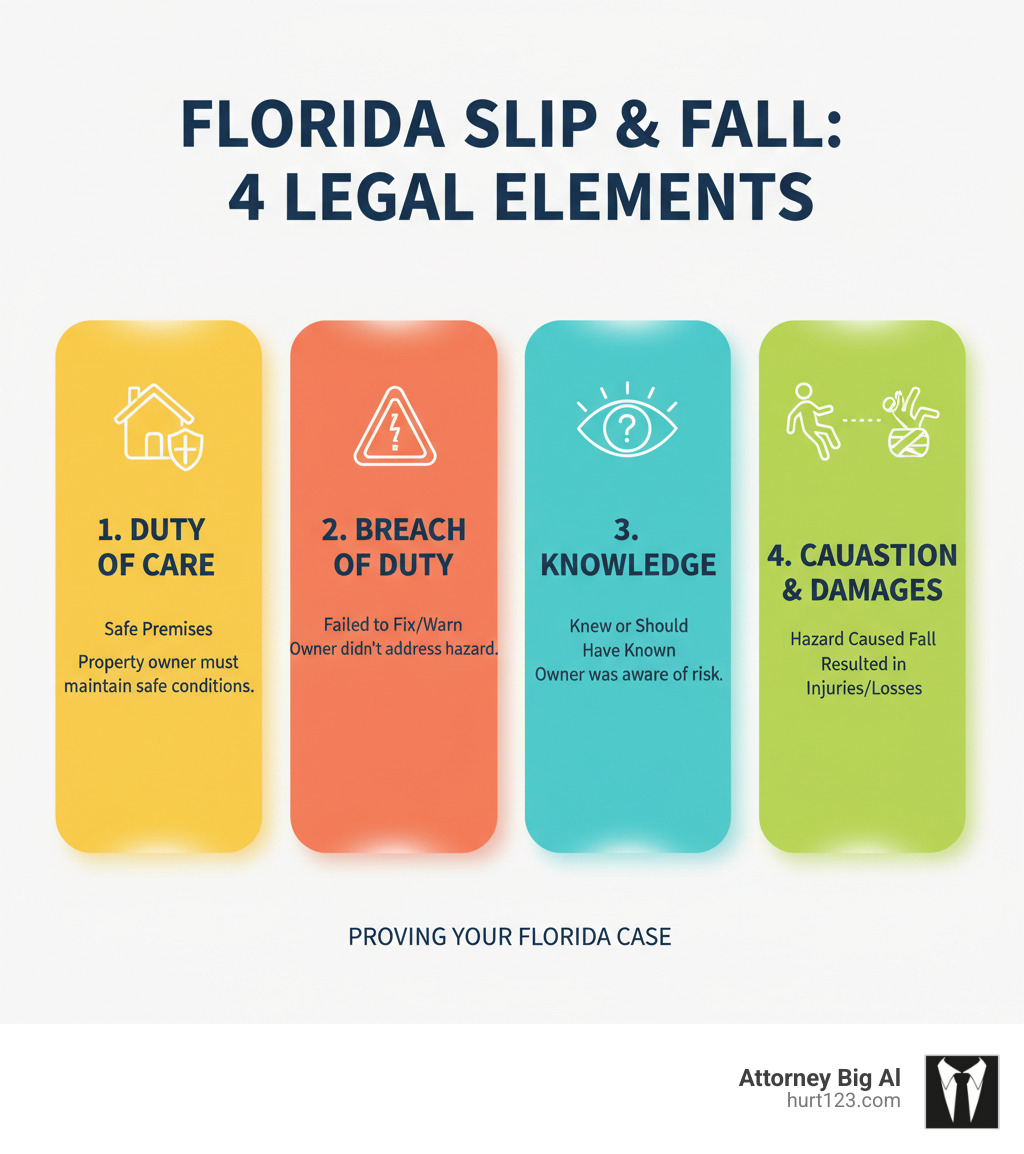
- Duty: Property owner must maintain safe premises for visitors
- Breach: Owner failed to fix or warn about dangerous conditions
- Knowledge: Must prove owner knew or should have known about the hazard
- Causation: The dangerous condition directly caused your fall
- Damages: You suffered actual injuries and financial losses
- Time Limit: 2 years to file a lawsuit in most cases
- Fault Rule: Your compensation reduces if you’re partially at fault (over 50% = no recovery)
At least one million people are hospitalized nationwide for slip and fall injuries each year. In Florida cities like Miami, Fort Lauderdale, and Hollywood, these accidents happen daily in hotels, restaurants, and shopping centers.
Florida’s legal requirements are stricter than many states. Under Florida Statute 768.0755, you must prove the business had “actual or constructive knowledge” of the dangerous condition. This means showing they knew about the hazard or should have found it through reasonable care. Because property owners and their insurance companies will often blame you or claim the danger was “open and obvious” to minimize your settlement, understanding these specific laws is essential before accepting any offer.
Navigating a Miami Slip and Fall Claim: What You Must Prove
Building a successful Florida slip and fall case requires proving several key elements. The law doesn’t make it easy for injured victims. Your case must show that the property owner had a duty to keep you safe, they failed in that duty, they knew or should have known about the danger, and their negligence directly caused your injuries. Missing any one of these elements can cause your claim to fail.
The Property Owner’s Duty of Care
Every Florida slip and fall case starts with one fundamental question: What did the property owner owe you? The answer depends entirely on why you were there in the first place.
As a customer or guest (an “invitee”), property owners owe you the highest duty of care. This means they must regularly inspect their property for hazards like wet floors or broken tiles, make repairs, and warn you of dangers. A Fort Lauderdale grocery store or Miami Beach hotel, for example, must actively look for problems, not just wait for accidents.
Social guests and others with permission – called “licensees” – get less protection. If you’re visiting a friend’s house in Boca Raton, they only need to warn you about dangers they actually know about. They don’t have to go hunting for problems on your behalf. Understanding these entrant categories is essential to knowing what duty of care applies in your specific situation.
Trespassers get the least protection, but Florida has some important exceptions. Property owners generally just can’t intentionally hurt trespassers or act with gross negligence. However, the attractive nuisance doctrine creates special rules for children. If you have a swimming pool, trampoline, or other kid magnet on your Sunrise property, you better secure it properly – even from trespassing children.
Understanding your visitor status is crucial because it sets the bar for what we need to prove the property owner should have done. For a deeper dive into these legal concepts, check out our guide on What is Premises Liability?.
Proving Negligence: Actual vs. Constructive Knowledge
Proving negligence in a Florida slip and fall case is challenging due to a strict state law. Under Florida Statute 768.0755, it’s not enough to show you fell; you must prove the business had either actual knowledge or constructive knowledge of the dangerous condition.
Actual knowledge means an employee saw the spill or broken tile and did nothing, or a customer had complained about it. Proving the business knew about the specific hazard that caused your fall makes for a strong case.
Constructive knowledge means proving the business should have known about the danger. Florida Statute 768.0755 allows this to be proven in two ways. First, by showing the hazard existed long enough that a reasonable inspection would have found it (e.g., a dirty, sticky spill with footprints). Second, by proving the dangerous condition happened regularly, like frequent spills at a Hollywood grocery store’s deli or a Fort Lauderdale nightclub, meaning the owner should have anticipated the hazard.

Common Defenses and Florida’s Comparative Negligence Rule
Property owners don’t just roll over and pay when you file a Florida slip and fall claim. They’ve got lawyers too, and those lawyers have a playbook full of defenses designed to blame you for your own accident.
The most common defense is “open and obvious danger.” They’ll argue that any reasonable person would have seen and avoided the hazard. Sometimes they’re right – if you walk into a clearly marked construction zone or ignore caution signs, you might have trouble winning your case.
But this defense isn’t automatic. Even obvious dangers can be the property owner’s responsibility if they should have anticipated that people would be distracted or face unreasonable risks. Think about busy tourist areas in Miami where people are naturally looking around, taking photos, or managing children.
Victim blaming is another favorite tactic. Insurance companies love to claim you were texting, not paying attention, wearing inappropriate shoes, or shouldn’t have been in that area at all. They’ll scrutinize every detail of your accident to find ways to make it your fault.
This brings us to Florida’s modified comparative negligence rule, which can dramatically impact your compensation. If you’re found partially at fault for your accident, your damages get reduced by your percentage of blame. Fall down and win $100,000, but get tagged with 30% fault? You only collect $70,000.
But here’s the real kicker: if you’re found 51% or more at fault, you get nothing. Zero. Zilch. This isn’t just a reduction in damages – it’s a complete bar to recovery. Florida’s comparative fault law makes it crucial to minimize any blame placed on you.
Deadlines and Damages in a Florida Slip and Fall Case
Time is not on your side in a Florida slip and fall case. Florida’s statute of limitations gives you a strict deadline to file your lawsuit, and missing it means losing your right to compensation forever.
For accidents happening after March 24, 2023, you have two years to file your lawsuit. That might sound like plenty of time, but it disappears faster than you’d think. Between recovering from your injuries, dealing with insurance companies, and gathering evidence, two years can slip away quickly.
Accidents before March 24, 2023, had a four-year deadline – but if you’re reading this now and your accident was that long ago, you need to act immediately. The clock doesn’t stop ticking just because you’re still hurt or dealing with medical treatment.
Government property cases are even trickier. If you fell at a city building in Sunrise or tripped on a county-maintained sidewalk in Boca Raton, special notice requirements and shorter deadlines often apply. These cases require immediate attention because the rules are different and the deadlines are often much shorter.
You can find all the specific deadlines in Florida Statute § 95.11, but the bottom line is simple: don’t wait.
When you do win your Florida slip and fall case, what can you recover? Medical bills are usually the biggest component – both what you’ve already paid and future treatment costs. Lost wages matter too, including time you’ll miss from work for ongoing treatment or permanent disability.
Pain and suffering compensation covers the physical discomfort and emotional distress from your injuries. Loss of enjoyment of life addresses how your injuries have changed your daily activities and hobbies.
The average Florida slip and fall settlement hovers around $30,000, but don’t let that number fool you. Severe injuries with clear liability can result in settlements or verdicts worth hundreds of thousands or even millions of dollars. Every case is different, and the value depends on your specific injuries, medical costs, lost income, and how clearly we can prove the property owner’s negligence.
The key is building a strong case that proves all the elements Florida law requires while minimizing any blame placed on you. That’s exactly what we do – we have the resources and knowledge to take on big insurance companies and fight for the compensation you deserve.
What to Do After a Slip and Fall in Boca Raton or Sunrise
If you slip and fall in a Boca Raton shopping plaza or a Sunrise restaurant, your first instinct might be embarrassment. However, the actions you take in the first few moments are critical for any potential Florida slip and fall claim. Staying calm and thinking clearly can protect your right to future compensation.
Immediate Steps to Protect Your Rights
Get medical help first. Adrenaline can mask serious injuries like fractures or concussions. Seeing a doctor immediately creates an official medical record linking your injuries to the fall, which is crucial evidence against insurance company claims that your injuries were pre-existing.
Report the incident immediately. Find the manager, ask them to create an incident report, and get a copy before you leave. Stick to the basic facts of when, where, and how you fell. Do not admit fault.
Document the scene. Use your phone to take photos and videos of the exact spot where you fell, from multiple angles. Get close-ups of any spill or hazard. Details like dirt or smudges can help prove how long the hazard was present. Also, photograph your visible injuries.

Talk to anyone who saw what happened. Independent witnesses can provide powerful testimony that supports your version of events. Get their names and phone numbers if possible.
Avoid admitting fault. It’s natural to say things like “I’m so clumsy,” but these statements can be used against you. Politely decline to give a recorded statement to an insurance adjuster until you have spoken with a lawyer.
Save your clothes and shoes. They may contain evidence. Also, keep a daily journal of your pain, medical appointments, and how the injuries affect your life. This record is valuable evidence of your damages.
For more specific guidance, especially if your accident happened while dining out, check out our detailed guide on What to Do If You Slip and Hurt Yourself at a Restaurant.
Why You Should Consider a Lawyer for Your Florida Slip and Fall Claim
You might be wondering if you really need legal help for a Florida slip and fall. Maybe you’re thinking the insurance company will be fair, or that your case seems straightforward. Unfortunately, that’s rarely how things work out.
Florida’s laws are more complicated than they appear. Tricky Florida Statute 768.0755 we discussed earlier? Proving the property owner had “constructive knowledge” of the dangerous condition requires specific legal strategies and evidence gathering techniques. Insurance companies know most people don’t understand these requirements, and they use that to their advantage.
Insurance companies are not your friends. I know that sounds harsh, but it’s true. The property owner’s insurance company has one primary goal – paying you as little as possible, or preferably nothing at all. They employ experienced adjusters who are skilled at finding reasons to deny claims or shift blame to you.
They might argue the hazard was “open and obvious,” question whether your injuries are really that serious, or try to prove you were mostly at fault for not paying attention. These are trained professionals going up against someone who’s never dealt with a legal claim before.
Building a strong case takes resources and knowledge. Winning a Florida slip and fall case often requires obtaining security camera footage (which businesses sometimes “accidentally” erase), interviewing witnesses, reviewing maintenance records, and sometimes hiring accident reconstruction specialists or medical professionals.
We know what evidence to look for and how to legally obtain it before it disappears. We also understand how to present that evidence in a way that clearly shows the property owner’s negligence.
Your claim is probably worth more than you think. Beyond your immediate medical bills, you may be entitled to compensation for future medical care, lost earning capacity, and the very real impact of pain and suffering on your life. We work with medical and financial professionals to calculate the true value of your damages.
The playing field needs to be level. When you’re dealing with a large corporation or their insurance company, you’re at a significant disadvantage. We have the financial resources and experience to challenge major insurance companies and pursue your case aggressively, whether through settlement negotiations or in court.
We understand the physical, emotional, and financial toll a serious slip and fall can take on you and your family. We’re here to handle the legal complexities so you can focus on getting better.
If you’ve been injured due to a property owner’s negligence, don’t try to go it alone. Contact a premises liability lawyer for help with your case today. We offer free consultations to discuss your specific situation and help you understand your options.
Let us fight for the compensation you deserve while you concentrate on your recovery.
