
Understanding When a Florida Nursing Home Fails a Resident
Key Takeaways: A nursing home complaint in Florida is a formal report that a facility has violated a resident’s legal rights, health, safety, or welfare under Fla. Stat. 400.022. Florida law extends good-faith immunity to anyone who reports concerns, while civil lawsuits are limited to the resident, guardian, authorized representative, or deceased resident’s personal representative. Complaints can be filed through AHCA, the long-term care ombudsman, or the state abuse hotline. Mandatory reporters must report suspected abuse, and state agencies must act quickly, AHCA resolves complaints within 60 days and protective investigations begin within 24 hours. Administrative complaints and civil lawsuits are separate paths, allowing families to pursue regulatory action, compensation, or both.
A nursing home complaint in Florida is a formal report that a facility, its staff, or another party has violated a resident’s legal rights, health, safety, or welfare. Florida law provides a clear mechanism for residents and families to raise concerns while protecting good-faith reporters. This guide explains what these complaints are, who may file, and how the process connects to broader legal protections.
If you suspect neglect or abuse, Attorney Big Al at 1-800-HURT-123 can help you understand your options. Call 1-800-487-8123 or use the online contact page to take the first step toward protecting your loved one.
What a Nursing Home Complaint Really Means Under Florida Law
A complaint measures a facility against legally required resident rights standards. Under Fla. Stat. 400.022(1), nursing home facilities must adopt and publicize a statement of resident rights and responsibilities and treat residents accordingly. A complaint claims the facility fell below this baseline. Review these protections in the Florida nursing home resident rights statute.
Core protections involve basic safety and dignity. The statute guarantees
the right to be free from mental and physical abuse, corporal punishment, extended involuntary seclusion, and from physical and chemical restraints
except those authorized by a physician or required by emergency. Common complaints include untreated bedsores, medication errors, falls, malnutrition, and unexplained injuries.
💡 Pro Tip: Request the facility’s written resident rights statement at admission. It lists ombudsman and abuse hotline contacts, providing a ready roadmap if problems arise.
Why the Written Rights Statement Matters
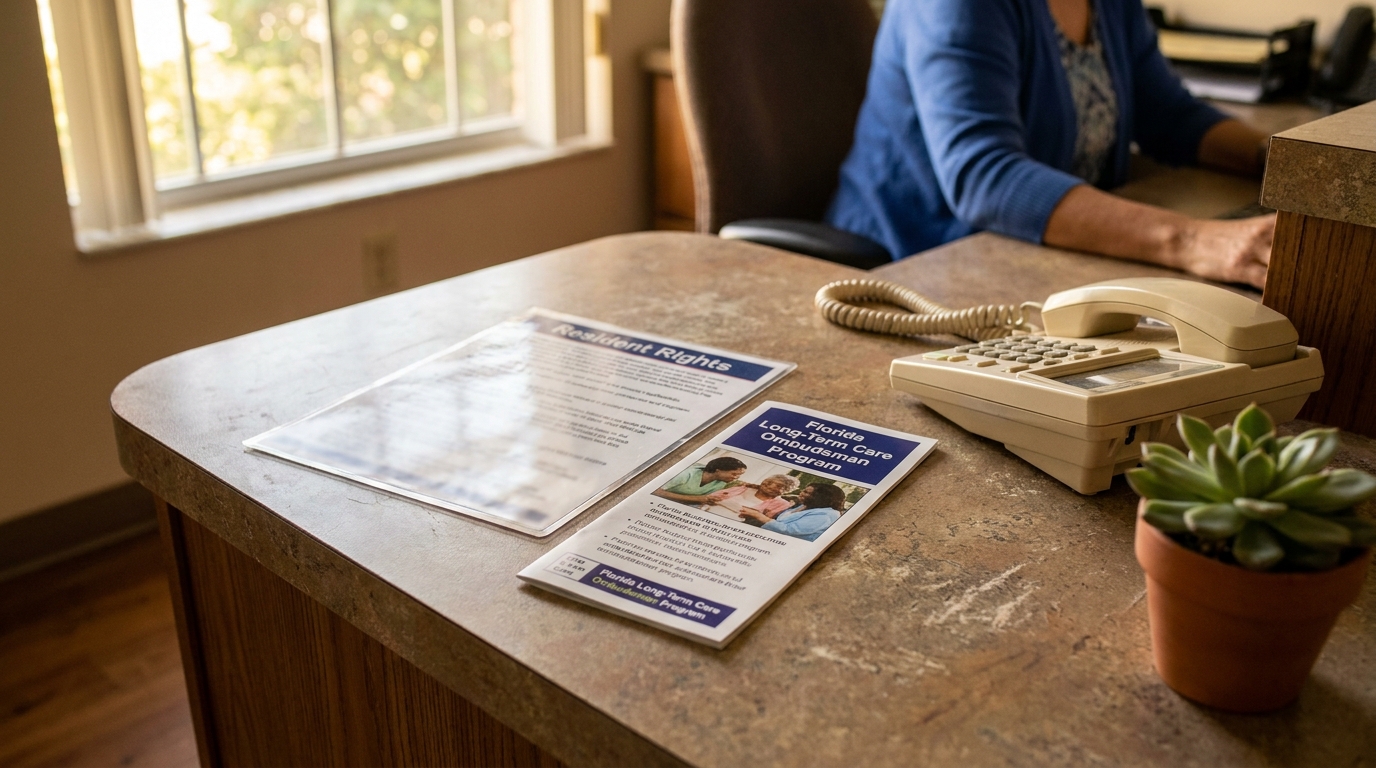
The written statement is a legally required disclosure. Under Fla. Stat. 400.022(2), facilities must orally inform residents of their rights and provide written documentation at or before admission.
The statement must be in boldfaced type and shall include the telephone number and e-mail address of the State Long-Term Care Ombudsman Program, the telephone numbers of the local ombudsman council, and the telephone numbers of the Elder Abuse Hotline operated by the Department of Children and Families.
This document enables families to act quickly.
Who Can File Nursing Home Complaints Florida Families Should Know
Florida law encourages reporting through broad protections. Under Fla. Stat. 400.022(4),
any person who submits or reports a complaint concerning a suspected violation of the resident’s rights or concerning services or conditions in a facility or who testifies in any administrative or judicial proceeding arising from such complaint shall have immunity from any criminal or civil liability therefor, unless that person has acted in bad faith, with malicious purpose, or if the court finds that there was a complete absence of a justiciable issue of either law or fact raised by the losing party.
Filing authority varies by pathway. For administrative complaints, the pool of reporters is wide. For civil enforcement, Florida narrows eligibility. Under Fla. Stat. 400.023(1)(a), a lawsuit may be brought by:
- The resident or their guardian
- A person or organization acting on the resident’s behalf with consent
- The personal representative of a deceased resident’s estate
Defendants can extend beyond the facility. Potential defendants include the licensee, management companies, managing employees, and direct caregivers, while passive investors are generally not liable.
💡 Pro Tip: Keep a dated log of injuries, staffing concerns, and facility conversations. Contemporaneous notes are persuasive evidence and preserve details memory may lose.
Where and How a Complaint Is Filed
Florida offers multiple channels serving different purposes. Report concerns to the Agency for Health Care Administration (AHCA), the long-term care ombudsman, or the state abuse hotline. Under Fla. Stat. 400.19(1), AHCA must generally complete its investigation and provide findings within 60 days.
Repeated problems trigger escalating oversight. Under Fla. Stat. 400.19(3), if a facility has been cited for a Class I deficiency, two or more Class II deficiencies arising from separate surveys or investigations within a 60-day period, or three or more substantiated complaints within a 6-month period each resulting in at least one Class I or Class II deficiency, AHCA must conduct surveys every 6 months for the next 2-year period and assess a total fine of $6,000 for the entire 2-year period, with one-half ($3,000) paid at the completion of each biannual survey. Filing complaints contributes to broader accountability, since any violation of a resident’s rights set forth in Fla. Stat. 400.022 constitutes grounds for agency action under Fla. Stat. 400.102, 400.121, or part II of chapter 408; additionally, Fla. Stat. 400.102 enumerates specific independent grounds for agency action such as intentional or negligent acts materially affecting resident health or safety.
For a practical walkthrough, this step-by-step guide to reporting a facility covers the process in Hollywood and Broward County.
The Role of Mandatory Reporters and the Abuse Hotline
Certain professionals must report suspected abuse. Under Fla. Stat. 415.1034(1)(a), professionals who know or reasonably suspect a vulnerable adult is being abused, neglected, or exploited must immediately report to the Florida central abuse hotline. Mandatory reporters include physicians, nurses, paramedics, hospital personnel, nursing home staff, social workers, law enforcement officers, ombudsman representatives, and financial institution employees. The vulnerable adult protection statute details these duties.
Effective reports include identifying details. Under Fla. Stat. 415.1034(1)(b), reports should include, to the extent possible, the victim’s name, age, race, sex, physical description, and location; the victim’s family members’ names, addresses, and phone numbers; the alleged perpetrator’s contact information; the caregiver’s contact information if different from the perpetrator; the reporter’s own name, address, and telephone number; a description of physical or psychological injuries sustained; actions taken by the reporter; and any other information that may establish the cause of abuse, neglect, or exploitation. Subsection (2) separately requires that suspected abuse-related deaths be reported immediately to the medical examiner and a criminal justice agency.
💡 Pro Tip: If a resident faces immediate danger, call the abuse hotline and 911 first. Administrative and civil remedies can follow, but safety comes first.
What Happens After a Report
State agencies must act quickly. Under Fla. Stat. 415.104(1), the Florida Department of Children and Families must begin protective investigation within 24 hours of receiving a report. If a caregiver interferes with the investigation, law enforcement must be contacted, and the department must notify the State Long-Term Care Ombudsman Program within 24 hours when abuse by a second party is alleged.
From Administrative Complaint to Civil Claim
Administrative complaints and civil lawsuits are separate but overlapping paths. Chapter 400, Part II provides civil enforcement distinct from AHCA complaints. Families may pursue regulatory action, a lawsuit, or both, subject to applicable requirements and deadlines.
Damages depend on case facts. Under Fla. Stat. 400.023(1)(b)-(d), if negligence caused death, claimants must elect either survival damages under Fla. Stat. 46.021 or wrongful death damages under Fla. Stat. 768.21. If the resident died from unrelated causes, the personal representative may recover damages for negligence-caused injuries. Both actual and punitive damages may be recoverable, and prevailing residents may recover attorney’s fees up to $25,000 for injunctive or administrative relief only. Timing is significant, and outcomes depend on specific facts.
| Pathway | Primary Goal | Typical Decision-Maker |
|---|---|---|
| AHCA complaint | Regulatory correction and penalties | Agency for Health Care Administration |
| Abuse hotline report | Protective investigation and safety | Department of Children and Families |
| Civil lawsuit | Compensation for the resident or estate | Florida courts |
Families considering a claim can learn more from a nursing home complaints Florida lawyer handling these cases locally.
💡 Pro Tip: Preserve care plans, medication records, and photographs early. This documentation becomes central to proving negligence, causation, and injury extent.
Frequently Asked Questions
-
Can I file a complaint if I am not the resident’s legal guardian?
Often yes, for administrative reports. Fla. Stat. 400.022(4) extends immunity to any person filing a good-faith complaint, unless that person has acted in bad faith, with malicious purpose, or if the court finds there was a complete absence of a justiciable issue of either law or fact raised by the losing party. Civil lawsuits are generally limited to the resident, guardian, authorized representative, or estate’s personal representative under Fla. Stat. 400.023(1)(a).
-
How long does AHCA take to respond to a complaint?
The agency has a defined window. Under Fla. Stat. 400.19(1), AHCA must generally complete its investigation and provide findings within 60 days. Timing varies with case complexity.
-
What rights are most commonly violated in nursing home abuse Florida cases?
Freedom from abuse and improper restraint tops the list. Fla. Stat. 400.022(1)(o) protects residents from mental and physical abuse, corporal punishment, extended seclusion, and unauthorized restraints. Neglect-related harm like pressure injuries and falls also commonly generates complaints.
-
Do I have to choose between a complaint and a lawsuit?
Not necessarily. Chapter 400, Part II recognizes both administrative and civil enforcement, so families may pursue both, subject to each path’s requirements. Understanding both before deciding is wise given applicable deadlines and presuit steps.
-
What if abuse is suspected after a resident has died?
Reporting duties still apply. Under Fla. Stat. 415.1034(2), suspected abuse-related deaths must be reported immediately to the medical examiner and a criminal justice agency. Personal representatives may pursue civil claims regardless of cause of death under Fla. Stat. 400.023(1)(a).
Protecting Your Loved One’s Rights With Confidence
Understanding nursing home complaints Florida families rely on begins with knowing available rights and pathways. From the abuse hotline to AHCA investigations and civil enforcement under Chapter 400, Florida law provides layered protections for residents facing neglect or abuse. The right path depends on your facts, deadlines, and desired outcome.
If you believe a loved one has been harmed, you don’t have to navigate alone. Contact Attorney Big Al at 1-800-HURT-123 to discuss your concerns. Call 1-800-487-8123 or use the confidential contact form to protect your family member’s rights and health.
