

Is car accident settlement taxable: Avoid 2025 Tax Traps
After the Crash: Understanding Your Settlement and Taxes
Is car accident settlement taxable? Many people ask this question. The general answer is no—most of your car accident settlement is not taxable. However, there are important exceptions.
Here’s a quick overview:
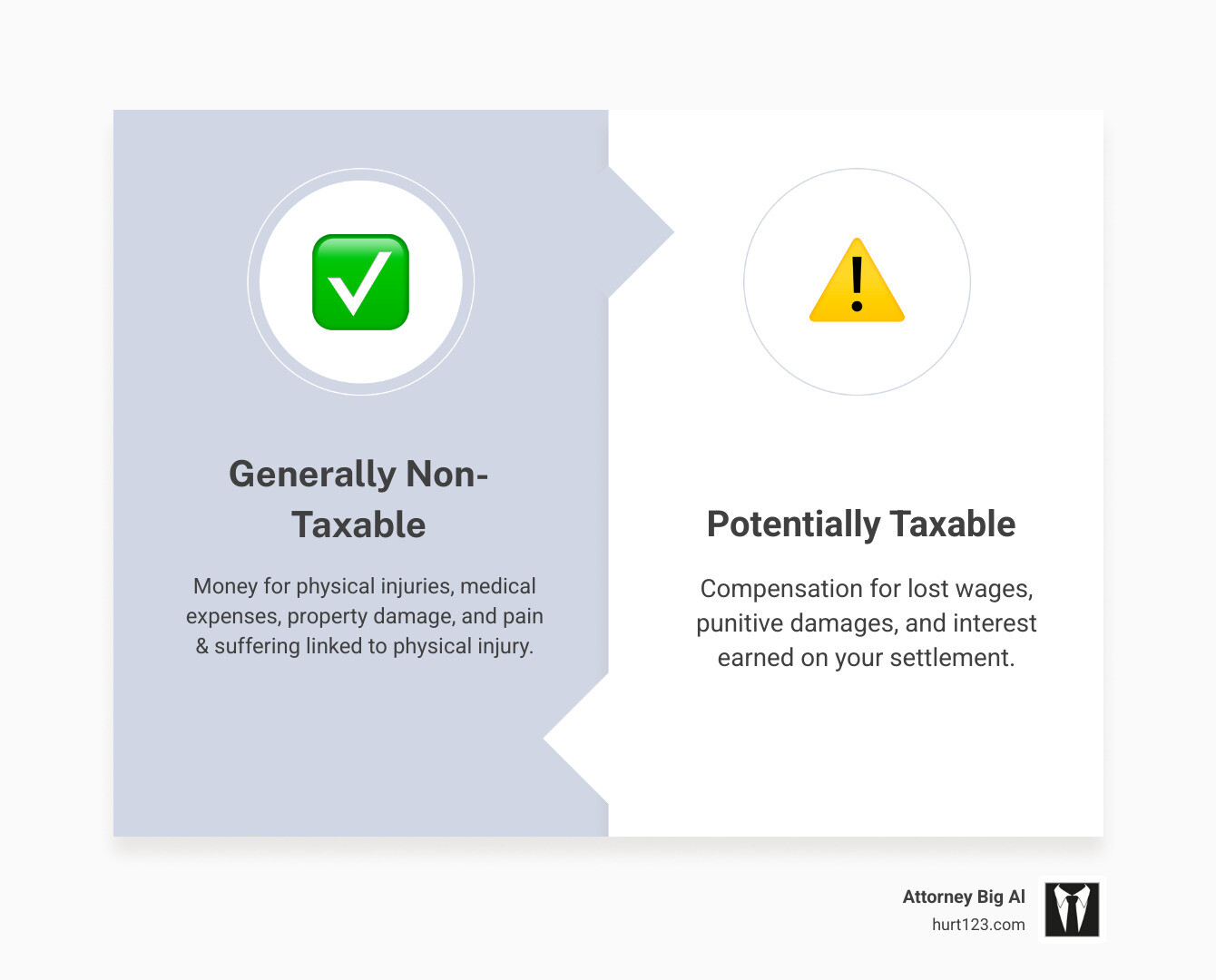
- Generally Non-Taxable: Money for physical injuries, medical expenses, and property damage. This includes pain and suffering directly related to a physical injury.
- Potentially Taxable: Compensation for lost wages, punitive damages, and interest earned on your settlement.
The aftermath of a car crash is stressful. After reaching a settlement, a surprise tax bill is the last thing you need. Understanding how the IRS views your compensation is key to financial planning.
Understanding the basics will help you manage your settlement with more confidence.
Quick Is car accident settlement taxable terms:
The General Rule: What the IRS Considers Taxable vs. Non-Taxable
After a car accident, getting a settlement is a huge step toward recovery. A common question is, “Will the IRS take a piece of my compensation?”
Good news: U.S. tax rules for personal injury settlements are guided by Internal Revenue Code (IRC) Section 104(a)(2). This section states that income doesn’t include money for “personal physical injuries or physical sickness.” In simple terms, if your settlement helps “make you whole” after a physical injury, it’s typically not taxed. This money is seen as replacing what you lost (health, property), not as a bonus. For example, compensation for pain and suffering from a physical injury is usually non-taxable. You can learn more about how our team approaches this by checking out Understanding Pain and Suffering in Personal Injury Claims: Insights from Boca Raton Injury Lawyers.
However, like most tax matters, there are twists. While compensation for physical injuries is usually safe from taxation, other parts of your settlement might not be. The IRS offers guidance on this in documents like Tax Implications of Settlements and Judgments | Internal Revenue Service. Let’s dive deeper.
What Parts of a Settlement Are Usually NON-TAXABLE?
Most of a car accident settlement is generally non-taxable, meaning more of the money you need to heal stays with you.
So, what falls into this category? Typically, any money you receive for medical bills and expenses is non-taxable. This covers costs like your emergency room visit, surgeries, doctor’s appointments, medications, and physical therapy. Funds for future medical care are also typically non-taxable.
Compensation for the actual physical pain and suffering you endured is also considered non-taxable. If you experienced emotional distress that came directly from your physical injuries—such as anxiety or PTSD after a severe physical impact—that compensation is usually non-taxable too. The key is the clear link to a physical injury. Compensation for disfigurement or physical impairment, like scars or a permanent disability, is also non-taxable.
Lastly, money to fix or replace your damaged vehicle or other personal items (property damage) is not considered taxable income. This includes the cost of a rental car. Essentially, if the compensation helps restore you to your pre-accident condition, especially regarding physical injuries, it’s typically excluded from your gross income. For more details, check out Damages Injury Lawyers in Boca Raton Help Recover.
What Parts of a Settlement Are Usually TAXABLE?
While much of your settlement is tax-free, some parts are considered taxable income by the IRS. Knowing these can prevent tax-season surprises.
One common taxable component is lost wages or income replacement. If your settlement includes money for income you couldn’t earn while injured, the IRS generally sees this as taxable because you would have paid taxes on that income if you had earned it. We’ll explore this more in the next section.
Another area to watch for is punitive damages. These are rare and aren’t meant to compensate you for a loss; they’re designed to punish the at-fault party for reckless behavior. Because punitive damages are a “windfall,” the IRS almost always considers them taxable income.
If your settlement takes time to pay out and accrues interest, that interest is taxable. Also, if you receive compensation for emotional distress without a physical injury, that portion is typically taxable. The IRS is clear: if emotional distress doesn’t stem from a physical injury, it’s not tax-exempt.
Finally, if you previously deducted medical expenses on a tax return and your settlement reimburses you for them, the amount you previously deducted can become taxable. The IRS prevents a “double dip” where you get a tax deduction and tax-free money for the same expense.
Understanding these differences is important for financial planning. When Attorney Big Al helps clients, we work to clearly assign damages in the settlement agreement to minimize potential tax issues. For more on how settlements are calculated, read our guide on How Are Settlements Calculated?.
Is Your Car Accident Settlement Taxable in Fort Lauderdale? A Deeper Dive
For residents of Fort Lauderdale and Florida, understanding settlement tax rules can be a challenge. While Florida has no state income tax, federal tax laws apply to money received after an injury. Let’s explore parts of your settlement that often raise tax questions.
How Are Lost Wages Treated if My Car Accident Settlement is Taxable?
If a car accident in Fort Lauderdale leaves you unable to work, your settlement will likely cover those lost wages or your future ability to earn. This is where the tax picture gets more involved.
The IRS generally sees compensation for lost wages as taxable income. Why? Because you would have paid income, Social Security, and Medicare taxes on that income if you had earned it. The IRS treats settlement money for lost wages the same way.
This means if a large part of your settlement is for lost wages, you must report it on your federal income tax return. This can sometimes push you into a higher tax bracket for that year.
It’s very important that your settlement agreement clearly shows how the money is divided, especially the amount for lost wages. This clarity helps you accurately report the taxable portion. Our car accident lawyers in Fort Lauderdale work to ensure these details are properly noted. If you’re dealing with lost wages, our team can help, just as our Miami Truck Wreck Attorney Help with Lost Wages assists truck accident victims.
Are Punitive Damages from a Car Accident Settlement Taxable?
Punitive damages are different from other compensation. They aren’t meant to cover your losses but to punish the at-fault party for reckless behavior and deter others from similar actions.
Since punitive damages are for punishment, not compensation, the IRS views them as a “windfall.” Therefore, punitive damages are almost always considered taxable income and added to your gross income.
In Florida, punitive damages are rare in car accident cases and are usually only awarded when someone was extremely negligent or intentionally caused harm. Florida law also limits how much can be awarded.
While uncommon in settlements, if your case includes them, be ready for them to be taxed. Understanding the difference between settling and going to trial is key, and our article on Settling vs. Trial: Injury Lawyers in Boca Raton offers more insight. You can also check the IRS definition of punitive damages for details.
Is Compensation for Emotional Distress Taxable After a Car Accident?
Emotional distress is a real and difficult part of car accidents. For tax purposes, compensation for emotional distress is taxable depending on its connection to a physical injury.
Here’s the important difference:
- Non-Taxable: If your emotional distress (like PTSD or anxiety) directly results from a personal physical injury caused by the accident, the compensation is generally non-taxable. The IRS sees this as part of the overall compensation for your physical harm.
- Taxable: If the emotional distress is not directly linked to a physical injury, the compensation is usually taxable. For instance, if you witnessed a crash and suffered emotional distress but were not physically hurt, any compensation would likely be taxable.
The IRS looks for a direct connection. If emotional distress causes physical symptoms (like headaches) but didn’t start with a physical injury, the compensation may be taxable. The wording in your settlement agreement is crucial for tax reasons.
The IRS gives guidance on this in publications like IRS Publication 4345 on Settlements. This publication highlights the importance of showing the link between physical injuries and emotional distress for it to be non-taxable. Our car accident lawyers in Fort Lauderdale aim to ensure your settlement terms clearly reflect this relationship, helping to answer the question, “Is car accident settlement taxable?” in the best way for you.
Strategic Planning in Boca Raton: How to Legally Minimize Your Settlement’s Tax Impact
A car accident settlement is a significant financial event. Smart tax planning is essential to keep as much of your compensation as possible. While we are car accident lawyers, not tax advisors, we can explain general principles to help minimize your tax burden. Always consult a qualified tax professional for specific advice.
Using Structured Settlements to Manage Your Compensation
One powerful tool for managing the tax implications of a large settlement is a structured settlement.
Instead of a single lump sum, a structured settlement provides a series of periodic payments over time, typically funded by an annuity purchased by the defendant’s insurance company.
Here’s why structured settlements can be beneficial:
- Tax-Free Payments for Physical Injury: For physical injury settlements, periodic payments from a structured settlement are generally tax-free. This includes both the principal and the interest generated by the annuity. This is a major advantage over a lump sum, where any investment earnings would be taxable.
- Long-Term Financial Security: Structured settlements provide a stable, predictable income stream, which is valuable for victims with long-term medical needs or those who can no longer work. It prevents the risk of quickly spending a large lump sum.
- Avoiding Higher Tax Brackets: If a lump sum includes taxable portions like lost wages, receiving it all in one year could push you into a higher tax bracket. A structured settlement can spread taxable payments over multiple years, potentially lowering your overall tax liability.
Structured settlements offer less flexibility than a lump sum and are not for everyone. The decision requires careful consideration of your long-term needs. For more information, you can read More on structured settlements, though the Canadian context may differ from U.S. law.
Are Earnings from Investing My Settlement Money Taxable?
The answer is almost always yes.
While the original core of your personal injury settlement is generally non-taxable, any earnings or gains you make by investing that money are taxable.
The initial settlement for your injury is tax-free. However, once you invest that money, any profits—such as interest, dividends, or capital gains—become taxable.
- Interest Income: From savings accounts, CDs, or bonds.
- Dividends: Payments from stocks you own.
- Capital Gains: Profits from selling an investment for more than you paid.
The type of tax you pay depends on the investment. It’s important to consult a qualified financial advisor after receiving a significant settlement to create an investment strategy that is mindful of tax implications.
Can I Deduct My Legal Fees for Tax Purposes?
When you work with a car accident lawyer on a contingency fee basis, you may wonder if those fees are tax-deductible. This area has changed in recent years.
The Tax Cuts and Jobs Act (TCJA) of 2017 suspended miscellaneous itemized deductions, which included certain legal fees, for tax years 2018 through 2025.
What this means for personal injury legal fees:
- Generally Not Deductible by You: For most personal physical injury cases, the legal fees are not deductible by you.
- Attorney’s Portion Not Taxable to You: The good news is that the portion of your settlement that goes to your attorney as their contingency fee is not considered taxable income to you. The IRS typically views this as the attorney’s earned income, not yours.
There are narrow exceptions, but for standard car accident cases, this usually doesn’t apply.
While you generally can’t deduct legal fees, our contingency fee structure means you pay nothing upfront. We only get paid if we win your case. If you’re curious about how legal fees work, read our article on Are Lawyer Fees Negotiable?.
Frequently Asked Questions About Car Accident Settlement Taxes in Miami
A car accident in Miami is complex, and settlement tax implications add more questions. Here are some frequently asked questions about car accident settlement taxes.
Do I have to report a non-taxable settlement to the IRS?
Even though most of your settlement for physical injuries is non-taxable, it’s still advisable to be transparent with the IRS.
Here’s why:
- IRS Reporting by Payers: Insurance companies often send a Form 1099 to the IRS reporting settlement payments. Even if the settlement is non-taxable to you, the IRS might receive a report of the payment.
- Avoiding Inquiries: If the IRS sees a reported payment but it’s not on your tax return, it could trigger an inquiry. Addressing it can avoid this headache.
- Documentation is Key: If you receive a Form 1099 for a settlement you believe is non-taxable, you should still report it on your tax return (often on Schedule 1, Part I, line 8z for “Other income”) and then subtract it with a clear explanation that it’s an excludable personal injury settlement under IRC Section 104(a)(2). This shows the IRS you’ve accounted for the payment.
Proactive transparency can save you stress down the line.
What happens if my settlement doesn’t specify what the money is for?
This is a critical point. If your settlement agreement doesn’t allocate funds to specific damages (medical, lost wages, pain and suffering, etc.), the IRS may deem the entire settlement taxable.
Without clear documentation, the IRS has no way to distinguish between non-taxable and taxable components. In ambiguous situations, they often default to taxing the whole amount.
This is why having a car accident lawyer is so vital. We work to ensure that:
- Clear Allocation: Your settlement agreement clearly specifies which portions are for non-taxable damages (physical injuries, medical costs) and which are for taxable ones (lost wages, punitive damages).
- IRS Compliance: The language used is consistent with IRS guidelines to help protect your settlement from unnecessary taxation.
- Minimizing Ambiguity: We strive to eliminate gray areas that could lead to an IRS audit.
Without clear allocation, you might have to prove to the IRS what each dollar was for, which can be challenging.
Who should I consult about the tax implications of my settlement?
As car accident lawyers, we provide general information and structure your settlement agreement advantageously, but we are not tax professionals. Tax law is complex.
Therefore, we strongly advise our clients to consult with two key professionals:
- Your Car Accident Lawyer: We handle the legal aspects, negotiate with the insurance company, and ensure the settlement agreement is drafted with clear damage allocations.
- A Qualified Tax Professional (Accountant or Tax Attorney): This is crucial. A tax professional can provide personalized advice, help you report the settlement correctly, and guide you on investment strategies.
Think of it as a team effort. We handle the legal fight to get you compensation, and your tax professional ensures you keep as much as legally possible.
Navigating Your Settlement with Confidence in Hollywood, FL
Receiving a car accident settlement is a huge step toward recovery. The question, Is car accident settlement taxable, is important, and you deserve a clear answer.
As we’ve explored, the good news is that the main part of your settlement is usually not taxable, including money for physical injuries, medical expenses, and related pain and suffering. This rule helps make you whole again without adding a tax burden to your recovery.
However, key exceptions exist. Compensation for lost wages, punitive damages, and any interest earned are typically subject to federal income tax. Emotional distress compensation can also be taxable if not linked to a physical injury.
For residents of Hollywood, FL, and across the state, understanding these tax details is why having a dedicated car accident lawyer is so valuable. We work to get you the most compensation possible and ensure your settlement agreement clearly shows what is taxable and what is not. While we can’t give tax advice, we will guide you through the process and stress the importance of talking with a qualified tax professional.
At Attorney Big Al, we are committed to providing professional and caring service. We have the financial strength to stand up to big insurance companies on your behalf. Our goal is to help you achieve the full financial recovery you deserve so you can focus on your healing journey.
If you or someone you care about has been hurt in a car accident in Hollywood, Fort Lauderdale, Miami, Boca Raton, Pembroke Pines, Sunrise, or West Palm Beach, please reach out. Contact an experienced Fort Lauderdale car accident lawyer at Attorney Big Al today for a free consultation. We are here to help you steer your settlement with confidence.
